 Summerlong (2016) by Peter S. Beagle is an interesting book that doesn't fit squarely into any one genre. It has a little bit of mystery, a little suspense, some touches of magic and the supernatural, and lots of personality and relationship drama, both family and romantic.
Showing posts with label Relationships. Show all posts
Showing posts with label Relationships. Show all posts
Tuesday, December 12, 2017
Summerlong by Peter S. Beagle
Summerlong (2016) by Peter S. Beagle is an interesting book that doesn't fit squarely into any one genre. It has a little bit of mystery, a little suspense, some touches of magic and the supernatural, and lots of personality and relationship drama, both family and romantic.
Tuesday, July 25, 2017
The Impossible Lives of Greta Wells
 The Impossible Lives of Greta Wells (2013) by Andrew Sean Greer was a lovely, quick read about how our choices can change us.
Wednesday, April 19, 2017
The Fiery Cross by Diana Gabaldon
The 5th book in Diana Gabaldon's Outlander series, The Fiery Cross (2001) follows immediately after the events of book 4, and therefore maintains both the wonderful writing and interesting characters and settings we've become used to.
Wednesday, February 15, 2017
The Winter People by Jennifer McMahon
 The Winter People (2014) by Jennifer McMahon is a wonderful book filled with excitement, mystery, troubling pasts, anticipation, and just enough of the supernatural (I won't say what kind -- that would give things away) to keep it interesting.
 Flipping back and forth between the past and the present, I liked the connection that created, with the story weaving the two time periods together very effectively. The "New England" feel of both the setting and the story was very appealing and familiar to me as a life-long (and proud) New Englander myself.
Though the book has supernatural elements, the story was really more about loss and the relationships between mothers and daughters, both with good and especially with not-so-good associations, so don't let the idea of the supernatural turn you off if that's not normally your 'thing'. This is an excellent book to read in poor weather in a cozy chair with a hot drink. A perfect winter book (as the title implies)!
“I think people see what they want to see... But think about it: if you'd lost someone you love, wouldn't you give almost anything to have the chance to see them again?”
Keep reading! Beth
Wednesday, December 21, 2016
The Owl Who Liked Sitting on Caesar by Martin Windrow
The Owl Who Liked Sitting on Caesar: Living with a Tawny Owl (2014) by Martin Windrow was a sweet book about an rather unusual (though at the same time so stereotypically British) relationship between a man and his owl.
 It was truly fascinating to read about the habits of owls and how they did (and, in many ways did not) fit in with human habitation. Windrow made abundantly clear that he respected that owls, even owls that have been hatched and raised by humans, are still wild animals. In most cases, by adjusting his own habits and expectations to fit in with living with the owl rather than expecting the owl to do so. In short, he was never under the illusion that he could fully domesticate her to live as a pet but rather worked very hard to make co-habitation work.
While I loved the relationship between Martin and Mumble, he also very effectively dissuaded me from ever wanting to live with an owl myself -- issues with excrement alone would be a deal-breaker!
I won't spoil the ending by commenting on that, but at the end I was very glad to have read this short, interesting, funny book.
Keep reading! Beth
It was truly fascinating to read about the habits of owls and how they did (and, in many ways did not) fit in with human habitation. Windrow made abundantly clear that he respected that owls, even owls that have been hatched and raised by humans, are still wild animals. In most cases, by adjusting his own habits and expectations to fit in with living with the owl rather than expecting the owl to do so. In short, he was never under the illusion that he could fully domesticate her to live as a pet but rather worked very hard to make co-habitation work.While I loved the relationship between Martin and Mumble, he also very effectively dissuaded me from ever wanting to live with an owl myself -- issues with excrement alone would be a deal-breaker!
I won't spoil the ending by commenting on that, but at the end I was very glad to have read this short, interesting, funny book.
Perched on the back of a sunlit chair was something about 9 inches tall and shaped rather like a plump toy penguin with a nose-job. It appeared to be wearing a one-piece knitted jumpsuit of pale grey fluff with brown stitching, complete with an attached balaclava helmet. From the face-hole of the fuzzy balaclava, two big, shiny black eyes gazed up at me trustfully. 'Kweep', it said quietly. Enchanted, I leaned closer. It blinked its furry grey eyelids, then jumped very deliberately up on to my right shoulder. It felt like a big, warm dandelion head against my cheek, and it smelt like a milky new kitten. 'Kweep', it repeated, very softly.
[...]
Love at first sight – when it hits you late, it hits hard. It hit me at thirty-four, and I was a slave to it for the next fifteen years.
Keep reading! Beth
Wednesday, September 21, 2016
Dad is Fat by Jim Gaffigan
 Dad is Fat (2013) by Jim Gaffigan (of the Hot Pockets joke fame) is absolutely hilarious, as expected! Even for someone without kids, many of his observations still resonated with me and made me laugh out loud - a lot!
He writes in a very tongue-in-cheek manner, often directly addressing the reader, always in a very funny way. I loved this style, which really made reading the book feel very intimate, like I was having a conversation rather than passively reading (which was of course what I was actually doing, but still...). He really made me feel 'in' on his jokes, and I loved it.
I don't want to spoil too many of the punch lines, but here were two of my favorite jokes from the book:
“Every morning after I get up, I always gaze longingly at my bed and lament, ‘You were wonderful last night. I didn’t want it to end. I can’t wait to see you again…’” (192)
“I guess you could say I’m allergic to camping. Jeannie loves camping because she says camping was a tradition in her family. I always point out that prior to the invention of the house, camping was a tradition in everyone’s family. I don’t get camping. ‘Hey, want to burn a couple of vacation days sleeping on the ground outside? Chances are you’ll wake up freezing and covered in a rash?” No, thanks. If camping was so great, why are the bugs always trying to get in your house?” (258-9)I completely agree Jim!
Keep reading! Beth
Wednesday, September 14, 2016
Paper Towns by John Green
 Paper Towns (2008) is John Green's third solo book, and I think his best of the ones I've read so far. It was sweet, funny, exciting, compelling, interesting... it had it all. Mystery, 'romance,' suspense, fear, longing, heartache and heartbreak, dead bodies, final exams, and a road trip. What more could you want?
 I really, really loved all these characters -- they were fun, funny, well-rounded, complete characters. It was a pleasure to live in their world for a little while. The road trip part was the best -- I was crying laughing at one point, and I really wished it had lasted longer.
The thing I loved the most about this book was that it was about a boy and a girl, and love, relationships, etc. but it wasn't REALLY about that -- it was about growing up and figuring out who you are and what you want, and accepting other people for who they truly are, and just figuring out people. So lovely!
The movie version was a pretty good adaptation -- of course not as complex and well-rounded as the book, and they left out some of my favorite parts of the book, but a nice movie in its own right. Good movie, great book!
"[E]ach of us starts out as a watertight vessel. And these things happen -- these people leave us, or don't love us, or don't get us, or we don't get them, and we lose and fail and hurt one another. And the vessel starts to crack open in places. And I mean, yeah, once the vessel starts to crack open, the end becomes inevitable... But there is all this time between when the cracks start to open up and when we finally fall apart. And it's only in that time that we can see one another, because we see out of ourselves through the cracks and into others through theirs... [O]nce the vessel cracks, the light can get in. The light can get out."--Quentin (p.302)
See my review of John Green's first two books here.
Keep reading! Beth
Monday, August 22, 2016
The Drums of Autumn (Outlander series #4)
The Drums of Autumn (1996) by Diana Gabaldon is yet another wonderful addition to this gripping series of time travel, romance, and family - and some violence and revenge.
 After the wonderful "Pirates of the Caribbean" plot that encompassed book #3 (see my review of that book here, and a staff roundtable review of books #1-2 here), Jaime and Claire are firmly settled in the New World, and so this book was filled with exciting stories of colonizing the American South in the mid-1700s.
I absolutely loved the framework of exploring and pioneering, especially setting up a homestead from scratch with almost nothing but bare hands and force of will. I really loved the slow, day-to-day scenes in the book, the small bits about putting up food and building structures. This is a period of time that has always fascinated me since my childhood obsession with the Little House books, and I was glad to have reminders of that in this (much more adult) series. One of the things I like best about historical fiction is the insight it gives readers into how people lived in a particular place and time, not just the big events that everyone learns about in school.
And, without giving too much away, there was quite a lot that happened in the book that surprised me, especially the storyline with Bree and Roger, and the plot with Ian. His story especially was part of the reason I could not put the book down in the second half - I just had to know what was going to happen with him!
One of my only complaints is how much Fergus has been pushed to the sidelines now that he's set up with his own family. I really like him -- indeed, he was perhaps my favorite character in books #2-3 -- and hope he becomes a more central character in the future (though not, I suppose, if that must come at the expense of his family!)
 After the wonderful "Pirates of the Caribbean" plot that encompassed book #3 (see my review of that book here, and a staff roundtable review of books #1-2 here), Jaime and Claire are firmly settled in the New World, and so this book was filled with exciting stories of colonizing the American South in the mid-1700s.
I absolutely loved the framework of exploring and pioneering, especially setting up a homestead from scratch with almost nothing but bare hands and force of will. I really loved the slow, day-to-day scenes in the book, the small bits about putting up food and building structures. This is a period of time that has always fascinated me since my childhood obsession with the Little House books, and I was glad to have reminders of that in this (much more adult) series. One of the things I like best about historical fiction is the insight it gives readers into how people lived in a particular place and time, not just the big events that everyone learns about in school.
And, without giving too much away, there was quite a lot that happened in the book that surprised me, especially the storyline with Bree and Roger, and the plot with Ian. His story especially was part of the reason I could not put the book down in the second half - I just had to know what was going to happen with him!
One of my only complaints is how much Fergus has been pushed to the sidelines now that he's set up with his own family. I really like him -- indeed, he was perhaps my favorite character in books #2-3 -- and hope he becomes a more central character in the future (though not, I suppose, if that must come at the expense of his family!)
“Forgiveness is not a single act, but a matter of constant practice”Keep reading! Beth
Wednesday, August 3, 2016
An Arsonist's Guide to Writer's Homes in New England by Brock Clarke
An Arsonist's Guide to Writer's Homes in New England (2007) by Brock Clarke is an interesting book, one I was a little conflicted about for most of the time I was reading.
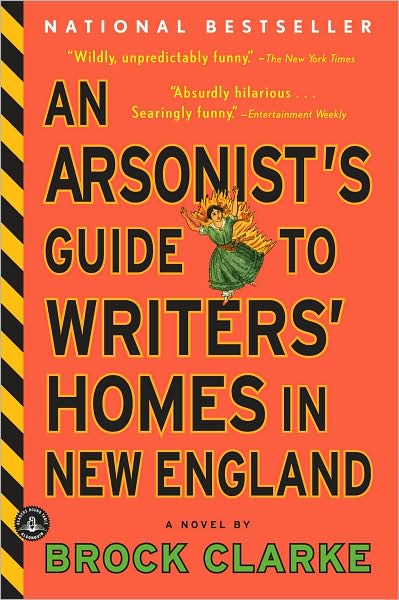
Following a completely avoidable accident that landed him in jail as a teenager, Sam Pulsifer's short break of normalcy following being released from prison as an adult is disrupted when his past comes back to haunt him (somewhat literally). Surrounded by other people also making poor decisions, this story was somewhat frustrating but also endearing at the same time; even though it was painful to read as Sam makes mistake after mistake, you can't help but feel for the guy.
At the end, I was mostly glad to have read the book. But one note of caution: do not bother to read this at all if you have a particular problem with main narrators who are (self-professed) bumbling idiots who make nothing but the obviously wrong decisions in every situation. There's a lot of that. But there is also decent character development, an interesting literary connection, and somewhat amusingly dysfunctional family relationships.
Following a completely avoidable accident that landed him in jail as a teenager, Sam Pulsifer's short break of normalcy following being released from prison as an adult is disrupted when his past comes back to haunt him (somewhat literally). Surrounded by other people also making poor decisions, this story was somewhat frustrating but also endearing at the same time; even though it was painful to read as Sam makes mistake after mistake, you can't help but feel for the guy.
At the end, I was mostly glad to have read the book. But one note of caution: do not bother to read this at all if you have a particular problem with main narrators who are (self-professed) bumbling idiots who make nothing but the obviously wrong decisions in every situation. There's a lot of that. But there is also decent character development, an interesting literary connection, and somewhat amusingly dysfunctional family relationships.
“If only my mother had a book to hold, she wouldn't have looked so lonely. And maybe this was another reason why people read: not so they would feel less lonely, but so that other people would think they looked less lonely with a book in their hands and therefore not pity them and leave them alone.”Keep reading! Beth
Tuesday, May 10, 2016
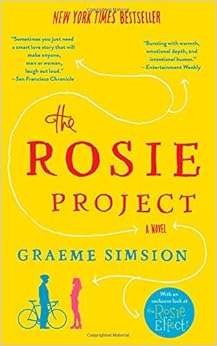
The Rosie Project by Graeme Simsion
The Rosie Project (2013) by Graeme Simsion was a sweet, surprising story about a man with many idiosyncrasies who struggles with accepting his own limitations in a world that (frustratingly) does not operate in the logical, orderly way he requires.

When I first started this book, I was really worried that the author would mock the main character and use his different-ness as comedic relief. But Don was an incredibly sympathetic character and I enjoyed his story immensely, especially coming from his unusual but understandable perspective. The Rosie of the title was a very interesting and decently complex character, who had her own plot developed outside of being the main love interest in the story -- always appreciated.
I loved that, since the reader was treated to Don's thought process but not Rosie's, he came off as the more likeable character, despite his own social issues contrasted to Rosie's "normal-ness". My only very small complaint is that the ending seemed a little rushed, but then again the point of the story was really about the journey and not the ending, which left the main characters in a satisfying way. To that end, I have waffled about whether or not to read the sequel, The Rosie Effect, since finishing The Rosie Project. I really liked this as a self-contained story and am very reluctant to get into another story that might muddle the waters, so to speak. For now, I was happy to have read this as a very good, heat-warming, stand-alone novel.
When I first started this book, I was really worried that the author would mock the main character and use his different-ness as comedic relief. But Don was an incredibly sympathetic character and I enjoyed his story immensely, especially coming from his unusual but understandable perspective. The Rosie of the title was a very interesting and decently complex character, who had her own plot developed outside of being the main love interest in the story -- always appreciated.
I loved that, since the reader was treated to Don's thought process but not Rosie's, he came off as the more likeable character, despite his own social issues contrasted to Rosie's "normal-ness". My only very small complaint is that the ending seemed a little rushed, but then again the point of the story was really about the journey and not the ending, which left the main characters in a satisfying way. To that end, I have waffled about whether or not to read the sequel, The Rosie Effect, since finishing The Rosie Project. I really liked this as a self-contained story and am very reluctant to get into another story that might muddle the waters, so to speak. For now, I was happy to have read this as a very good, heat-warming, stand-alone novel.
"It was also obvious that Rosie had very poor taste in coffee -- or she had done as I had and ignored the label 'coffee' and was enjoying it as an entirely new beverage. The technique was working brilliantly." (201)Keep reading! Beth
Monday, February 1, 2016
Ruth Galloway Series #2-4 by Elly Griffiths
Ruth Galloway mysteries is a series of books written by Elly Griffiths, which center around the life of one (surprise, surprise) Ruth Galloway, a forensic archaeologist who teaches at a university in the Norfolk region of England and occasionally consults with the local police in cases involving unidentified bones. Ruth is a very likable, endearing character who -- despite being the 'heroine' of her own series -- is definitely human enough (and makes enough mistakes) to be truly relatable. I have greatly enjoyed the series so far, and look forward to reading the rest soon!
For my review of the first book in the series, see this post from this past summer.
#2: The Janus Stone (2010)
 I liked how realistic this story was, in the sense that lots of intelligent people contributed to solving the case, rather than one person displaying super-human skills of deduction. I also liked that at the end, though Ruth again was the one who ended up in danger, she saved herself just as much as (or more than) the men who rushed to her rescue.
#3: The House at Sea's End (2011)
One of the great things about this series is the secondary characters, and how they are developing as we get to know them better. Judy (the policewoman) is especially becoming an interesting character, unhappy as she already is in her new marriage. Of course Ruth ends up in mortal peril again in this book, but unlike the previous two books in the series, the ending was a total surprise; I had not guessed at all who the killer was and was totally fooled by all the twists in the story.
#4: A Room Full of Bones (2012)
Though in general, I'm not super thrilled by the whole affair story line developed early in the series, I do like the way Elly is handling the love triangle, and the continued development of the secondary characters. Cathbad especially is such an interesting character -- sometimes a bit too stereotypical, but always intriguing and very charming. I'm interested to see if he continues to be such a constant presence in the cases in future books. It's one of those instances where it feels like a bit of a stretch for him to be involved in every case (a bit along the lines of Ruth's involvement in the first place), but he's a such a great character I hope he sticks around.
The danger for a mystery series with a non-detective in the lead is that sometimes the ways to get the main character involved in each case gets more and more unrealistic. Ruth's involvement is addressed somewhat by her status as an official consultant, and of course there are plenty of local cases that are not mentioned that she has no hand in at all. Still, I hope that the core stories in each book continue to justify her central role in each investigation in a believable manner. Regardless, outside of the case details in each book (which are always interesting), it really is the characters that make these books worth reading.
Keep reading! Beth
For my review of the first book in the series, see this post from this past summer.
#2: The Janus Stone (2010)
 I liked how realistic this story was, in the sense that lots of intelligent people contributed to solving the case, rather than one person displaying super-human skills of deduction. I also liked that at the end, though Ruth again was the one who ended up in danger, she saved herself just as much as (or more than) the men who rushed to her rescue.
#3: The House at Sea's End (2011)
One of the great things about this series is the secondary characters, and how they are developing as we get to know them better. Judy (the policewoman) is especially becoming an interesting character, unhappy as she already is in her new marriage. Of course Ruth ends up in mortal peril again in this book, but unlike the previous two books in the series, the ending was a total surprise; I had not guessed at all who the killer was and was totally fooled by all the twists in the story.
#4: A Room Full of Bones (2012)
Though in general, I'm not super thrilled by the whole affair story line developed early in the series, I do like the way Elly is handling the love triangle, and the continued development of the secondary characters. Cathbad especially is such an interesting character -- sometimes a bit too stereotypical, but always intriguing and very charming. I'm interested to see if he continues to be such a constant presence in the cases in future books. It's one of those instances where it feels like a bit of a stretch for him to be involved in every case (a bit along the lines of Ruth's involvement in the first place), but he's a such a great character I hope he sticks around.
The danger for a mystery series with a non-detective in the lead is that sometimes the ways to get the main character involved in each case gets more and more unrealistic. Ruth's involvement is addressed somewhat by her status as an official consultant, and of course there are plenty of local cases that are not mentioned that she has no hand in at all. Still, I hope that the core stories in each book continue to justify her central role in each investigation in a believable manner. Regardless, outside of the case details in each book (which are always interesting), it really is the characters that make these books worth reading.
Keep reading! Beth
Tuesday, January 26, 2016
Garden Spells by Sarah Addison Allen
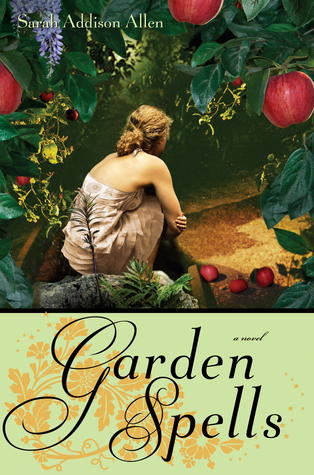 Garden Spells (2007) by Sarah Addison Allen is a book about family with just a touch of fantasy, and a Southern romance with a lot of whimsy.
I loved the quirky setting and the exaggerated characters of each of the families in this small, unique town. And I liked how fantasy elements were just woven into the story, as if that's how things are in the real world -- magic is always just right there under the surface waiting for the right circumstances to come out. Even a simple, everyday action like cooking food or cutting hair can create its own magic.
But the magic was only a small part of the book; the story itself is about relationships: romantic and familial, exciting, strained, and violent. At the heart of the story is the bond between two sisters who have had an unusual and not altogether loving relationship in the past. But the differences that kept them apart as children and young adults are also the things that have the potential to connect them as adults now that they are reunited. I liked that this was the relationship at the core of the book, and the rest of the story lines with romantic partners and others was important but somewhat secondary.
The secondary characters were all interesting and compelling, and the main characters were very easy to like and sympathize with. That combined with a great story and lovely, unique setting made this a really wonderful book.
“When you're happy for yourself, it fills you. When you're happy for someone else, it pours over. It was almost too bright to watch.”
Keep reading! Beth
Wednesday, January 20, 2016
Fun Home: A Family Tragicomic
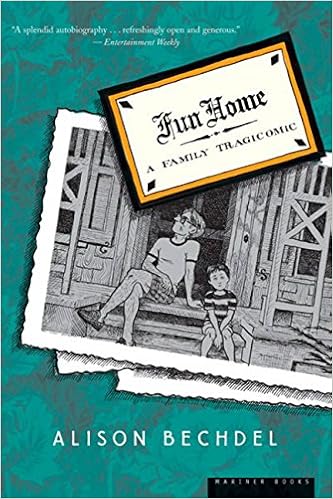 Fun Home: A Family Tragicomic (2006) by Alison Bechdel is a memoir in graphic novel form, a somewhat new format for me. While I love the Sunday comics, I've never been much of a graphic novel person - I sometimes find them to be visually overwhelming, like my eyes don't know where to look. Luckily, this book was arranged in a way that was very easy to follow.
I didn't know much about Bechdel before reading this book, in fact had not even realized that the now-famous Bechdel test was named after someone contemporary. The story itself is of her somewhat chaotic childhood and early adulthood, dealing with her father's mental health and identity issues as well as her own.
She grew up in quite a dysfunctional household, and I admire the way in which she writes and draws these events from her past in what seems to be a very truthful way, and even with some humor. I liked the foundation of classic literature, as something she and her dad connected over and a framework she used to make sense of her somewhat troubled past. Also interesting was the perspective of coming out as a lesbian in late 70s/early 80s. Fair warning: a few small scenes put the 'graphic' in graphic novel.
Overall, I greatly enjoyed learning about the very interesting Alison Bechdel, having a very quick read that still gave me great insight into a particular place and time, and getting a very easy introduction to the world of graphic novels. I'm excited to get into many more in the future!
"I employ these allusions to James and Fitzgerald not only as descriptive devices, but because my parents are most real to me in fictional terms."
Keep reading! Beth
Wednesday, December 16, 2015
Fangirl by Rainbow Rowell
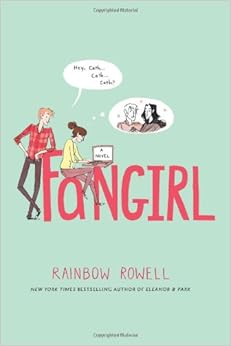 Rainbow Rowell's Fangirl (2013) is a great book for any introvert - or anyone who wants to understand introverts. Cath is a college freshman dealing with her much more outgoing twin sister, bi-polar dad, absent mom, standoffish roommate, roommate’s flirty boyfriend, and writing partner with questionable motives. The way Rowell writes all these characters is wonderful; she has a way with personalities and dialogue that made this book very hard to put down.
The thread through the whole book is the fantasy fanfiction Cath is writing, which weaves throughout the ‘real’ life of the story and is what connects or separates Cath from most of the people in her life, including her sister and her writing professor. There are tantalizing glimpses of both the story Cath is writing and the books her characters are based on, which adds an interesting dimension to the story.
Rowell is really great at capturing the feeling of being young and dealing with the strange transition in college between childhood and adulthood, and I really found myself empathizing with Cath very closely. A large part of this was the way in which Cath struggles as an introvert to adapt to the new environment of college, being surrounded by strangers and new expectations of how to 'be cool' and fit in.
The ending was fairly open-ended, but in a way that made sense. Most of the main storylines were pretty well wrapped up, and nothing was left hanging so much as while the story of Cath's freshman year was ending, life was continuing for each character and that’s okay. This was a really great book that I’ve recommended to everyone since I finished. My favorite non-fantasy young adult book so far (sorry John Green; I love you but I just found myself connecting with a female lead character more).
“In new situations, all the trickiest rules are the ones nobody bothers to explain to you. (And the ones you can't Google.)” (page 15)
Keep reading! Beth
Monday, November 16, 2015
John Green, Pt. 1: The early works
In addition to Neil Gaiman, the other author of whom I have long been a fan without having read much (or any) of his books is John Green. I am a devoted fan of the many educational YouTube channels John and his brother Hank produce, including VlogBrothers, Crash Course, SciShow, and Mental Floss, and the podcast they do together, Dear Hank and John (all are wonderful and interesting). Both Green brothers are intelligent, funny, and kind, and I admire them both. About time, then, that I explored the many books that brought John Green to attention in the first place, starting with some of his earlier works.
Looking for Alaska (2005)
 Unfortunately I do have to start by saying that at first I was not especially taken with this book, filled as it was with either awkward, whiny teenagers or rebellious, irresponsible teenagers. I just didn’t connect with the characters at first, which I think is more of a function of the genre than the author. Contemporary Young Adult novels are not normally my genre of choice; what YA books I read are all fantasy-based. So I wonder how much of my initial reluctance was simply the lack of magic and mythology I'm used to in YA books.
Regardless, once I got to know the characters more, and especially their back stories, I liked them much more. The way the story dealt with death in the later part was very moving and – I think – pretty accurate. Of course everyone deals with death differently, so I’m not sure it would have been possible to have been inaccurate per se, but regardless it felt very real and personal to me and helped me connect with the way the characters were feeling. And there were some very nice life lessons in the end.
An Abundance of Katherines (2006)
 I did enjoy this book more than Alaska from the start. Though there was still a bit more teen angst than I’m accustomed to in the stories I choose to read, I liked all the main characters in this story much more quickly. Though I’m not sure what it says about my deeper foray into YA literature that maybe the character I liked the best was the adult (maybe that’s a sign that I’m getting to old to read YA – to which I say, no such thing! I still read children’s books too).
One major plot thread – taking down oral histories of members in a specific community – was something I found very intriguing, and I really appreciated that the characters were working toward something interesting and concrete. This connection with the community, especially with outsiders (as the two main characters were), I thought elevated the book beyond just 'YA' to a story that is relatable to all ages (though I don't really think most YA books should be read just by teenagers; I know many adults who read them).
I like that John Green doesn’t speak down to his readers, that he assumes a certain amount of intelligence on our part (not an unreasonable amount; he is neither snobby nor preachy in his writing, which is also certainly appreciated). Overall, I'm glad I read both these books and look forward to reading some of his later works sometime soon.
Keep reading! Beth
Looking for Alaska (2005)
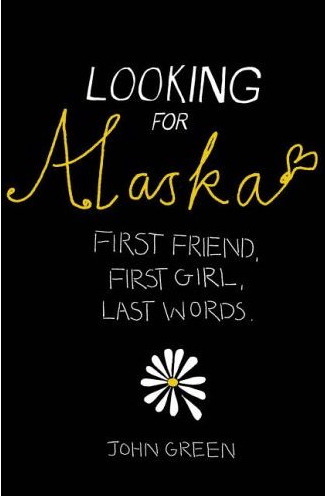 Unfortunately I do have to start by saying that at first I was not especially taken with this book, filled as it was with either awkward, whiny teenagers or rebellious, irresponsible teenagers. I just didn’t connect with the characters at first, which I think is more of a function of the genre than the author. Contemporary Young Adult novels are not normally my genre of choice; what YA books I read are all fantasy-based. So I wonder how much of my initial reluctance was simply the lack of magic and mythology I'm used to in YA books.
Regardless, once I got to know the characters more, and especially their back stories, I liked them much more. The way the story dealt with death in the later part was very moving and – I think – pretty accurate. Of course everyone deals with death differently, so I’m not sure it would have been possible to have been inaccurate per se, but regardless it felt very real and personal to me and helped me connect with the way the characters were feeling. And there were some very nice life lessons in the end.
"We need never be hopeless, because we can never be irreparably broken... We cannot be born, and we cannot die. Like all energy, we can only change shapes and sizes and manifestations... [T]hat part of us greater than the sum of our parts cannot begin and cannot end, and so it cannot fail." (page 220-1)
An Abundance of Katherines (2006)
 I did enjoy this book more than Alaska from the start. Though there was still a bit more teen angst than I’m accustomed to in the stories I choose to read, I liked all the main characters in this story much more quickly. Though I’m not sure what it says about my deeper foray into YA literature that maybe the character I liked the best was the adult (maybe that’s a sign that I’m getting to old to read YA – to which I say, no such thing! I still read children’s books too).
One major plot thread – taking down oral histories of members in a specific community – was something I found very intriguing, and I really appreciated that the characters were working toward something interesting and concrete. This connection with the community, especially with outsiders (as the two main characters were), I thought elevated the book beyond just 'YA' to a story that is relatable to all ages (though I don't really think most YA books should be read just by teenagers; I know many adults who read them).
"I don't think you can ever fill the empty space with the thing you lost... I don't think your missing pieces ever fit inside you again once they go missing." (page 201)
I like that John Green doesn’t speak down to his readers, that he assumes a certain amount of intelligence on our part (not an unreasonable amount; he is neither snobby nor preachy in his writing, which is also certainly appreciated). Overall, I'm glad I read both these books and look forward to reading some of his later works sometime soon.
Keep reading! Beth
Subscribe to:
Posts (Atom)