Showing posts with label Mental Illness. Show all posts

Wednesday, June 29, 2016

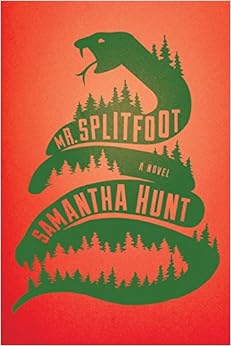
Mr. Splitfoot by Samantha Hunt

Here are the words that came to me as I read Mr. Splitfoot (2016) by Samantha Hunt:
dysfunction
chaos
suspense
sadness
fear
confusion 
A strange book, about which I was unsure for most of the time I was reading. Even more than half-way through, I was wondering why I was actually still reading it, especially as there was not nearly as much fantasy as the front flap description implied. But the story kept me going; I wasn't necessarily loving or even enjoying the book, but I really wanted to know what happened next.

Then twist ending made it worth it -- not only was it surprising, but it also resolved everything pretty neatly (which I always appreciate). A few things still left unsaid maybe, but anything not specifically explained was at least suggested -- good enough for me.

After I finished reading, this was one of those books that I had to just sit and think about for a few minutes, especially regarding people's general goodness (or lack thereof). The story really turned an unpleasant mirror on a sub-set of our culture most people try to ignore / forget about. Overall, this was a very interesting book that really made me think, and I was glad to have read it.
“Why do the living assume the dead know better than we do? Like they gained some knowledge by dying, but why wouldn't they just be the same confused people they were before they died?”

Keep reading! Beth


Tuesday, May 10, 2016

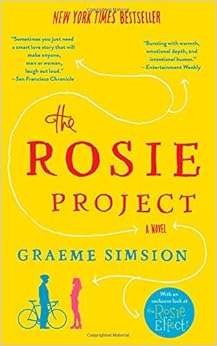
The Rosie Project by Graeme Simsion

The Rosie Project (2013) by Graeme Simsion was a sweet, surprising story about a man with many idiosyncrasies who struggles with accepting his own limitations in a world that (frustratingly) does not operate in the logical, orderly way he requires.

When I first started this book, I was really worried that the author would mock the main character and use his different-ness as comedic relief. But Don was an incredibly sympathetic character and I enjoyed his story immensely, especially coming from his unusual but understandable perspective. The Rosie of the title was a very interesting and decently complex character, who had her own plot developed outside of being the main love interest in the story -- always appreciated.

I loved that, since the reader was treated to Don's thought process but not Rosie's, he came off as the more likeable character, despite his own social issues contrasted to Rosie's "normal-ness". My only very small complaint is that the ending seemed a little rushed, but then again the point of the story was really about the journey and not the ending, which left the main characters in a satisfying way. To that end, I have waffled about whether or not to read the sequel, The Rosie Effect, since finishing The Rosie Project. I really liked this as a self-contained story and am very reluctant to get into another story that might muddle the waters, so to speak. For now, I was happy to have read this as a very good, heat-warming, stand-alone novel.
"It was also obvious that Rosie had very poor taste in coffee -- or she had done as I had and ignored the label 'coffee' and was enjoying it as an entirely new beverage. The technique was working brilliantly." (201)
Keep reading! Beth

Wednesday, January 20, 2016

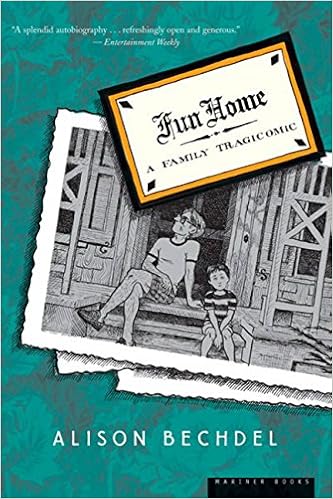
Fun Home: A Family Tragicomic

Fun Home: A Family Tragicomic (2006) by Alison Bechdel is a memoir in graphic novel form, a somewhat new format for me. While I love the Sunday comics, I've never been much of a graphic novel person - I sometimes find them to be visually overwhelming, like my eyes don't know where to look. Luckily, this book was arranged in a way that was very easy to follow.

I didn't know much about Bechdel before reading this book, in fact had not even realized that the now-famous Bechdel test was named after someone contemporary. The story itself is of her somewhat chaotic childhood and early adulthood, dealing with her father's mental health and identity issues as well as her own.

She grew up in quite a dysfunctional household, and I admire the way in which she writes and draws these events from her past in what seems to be a very truthful way, and even with some humor. I liked the foundation of classic literature, as something she and her dad connected over and a framework she used to make sense of her somewhat troubled past. Also interesting was the perspective of coming out as a lesbian in late 70s/early 80s. Fair warning: a few small scenes put the 'graphic' in graphic novel.

Overall, I greatly enjoyed learning about the very interesting Alison Bechdel, having a very quick read that still gave me great insight into a particular place and time, and getting a very easy introduction to the world of graphic novels. I'm excited to get into many more in the future!

"I employ these allusions to James and Fitzgerald not only as descriptive devices, but because my parents are most real to me in fictional terms."
Keep reading! Beth

Wednesday, December 16, 2015

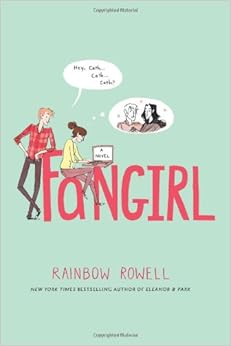
Fangirl by Rainbow Rowell

Rainbow Rowell's Fangirl (2013) is a great book for any introvert - or anyone who wants to understand introverts. Cath is a college freshman dealing with her much more outgoing twin sister, bi-polar dad, absent mom, standoffish roommate, roommate’s flirty boyfriend, and writing partner with questionable motives. The way Rowell writes all these characters is wonderful; she has a way with personalities and dialogue that made this book very hard to put down.

The thread through the whole book is the fantasy fanfiction Cath is writing, which weaves throughout the ‘real’ life of the story and is what connects or separates Cath from most of the people in her life, including her sister and her writing professor. There are tantalizing glimpses of both the story Cath is writing and the books her characters are based on, which adds an interesting dimension to the story.

Rowell is really great at capturing the feeling of being young and dealing with the strange transition in college between childhood and adulthood, and I really found myself empathizing with Cath very closely. A large part of this was the way in which Cath struggles as an introvert to adapt to the new environment of college, being surrounded by strangers and new expectations of how to 'be cool' and fit in.

The ending was fairly open-ended, but in a way that made sense. Most of the main storylines were pretty well wrapped up, and nothing was left hanging so much as while the story of Cath's freshman year was ending, life was continuing for each character and that’s okay. This was a really great book that I’ve recommended to everyone since I finished. My favorite non-fantasy young adult book so far (sorry John Green; I love you but I just found myself connecting with a female lead character more).
“In new situations, all the trickiest rules are the ones nobody bothers to explain to you. (And the ones you can't Google.)” (page 15)
Keep reading! Beth