The 5th book in Diana Gabaldon's Outlander series, The Fiery Cross (2001) follows immediately after the events of book 4, and therefore maintains both the wonderful writing and interesting characters and settings we've become used to.
Showing posts with label Romance. Show all posts
Showing posts with label Romance. Show all posts
Wednesday, April 19, 2017

Monday, August 22, 2016
The Drums of Autumn (Outlander series #4)
The Drums of Autumn (1996) by Diana Gabaldon is yet another wonderful addition to this gripping series of time travel, romance, and family - and some violence and revenge.
 After the wonderful "Pirates of the Caribbean" plot that encompassed book #3 (see my review of that book here, and a staff roundtable review of books #1-2 here), Jaime and Claire are firmly settled in the New World, and so this book was filled with exciting stories of colonizing the American South in the mid-1700s.
I absolutely loved the framework of exploring and pioneering, especially setting up a homestead from scratch with almost nothing but bare hands and force of will. I really loved the slow, day-to-day scenes in the book, the small bits about putting up food and building structures. This is a period of time that has always fascinated me since my childhood obsession with the Little House books, and I was glad to have reminders of that in this (much more adult) series. One of the things I like best about historical fiction is the insight it gives readers into how people lived in a particular place and time, not just the big events that everyone learns about in school.
And, without giving too much away, there was quite a lot that happened in the book that surprised me, especially the storyline with Bree and Roger, and the plot with Ian. His story especially was part of the reason I could not put the book down in the second half - I just had to know what was going to happen with him!
One of my only complaints is how much Fergus has been pushed to the sidelines now that he's set up with his own family. I really like him -- indeed, he was perhaps my favorite character in books #2-3 -- and hope he becomes a more central character in the future (though not, I suppose, if that must come at the expense of his family!)
 After the wonderful "Pirates of the Caribbean" plot that encompassed book #3 (see my review of that book here, and a staff roundtable review of books #1-2 here), Jaime and Claire are firmly settled in the New World, and so this book was filled with exciting stories of colonizing the American South in the mid-1700s.
I absolutely loved the framework of exploring and pioneering, especially setting up a homestead from scratch with almost nothing but bare hands and force of will. I really loved the slow, day-to-day scenes in the book, the small bits about putting up food and building structures. This is a period of time that has always fascinated me since my childhood obsession with the Little House books, and I was glad to have reminders of that in this (much more adult) series. One of the things I like best about historical fiction is the insight it gives readers into how people lived in a particular place and time, not just the big events that everyone learns about in school.
And, without giving too much away, there was quite a lot that happened in the book that surprised me, especially the storyline with Bree and Roger, and the plot with Ian. His story especially was part of the reason I could not put the book down in the second half - I just had to know what was going to happen with him!
One of my only complaints is how much Fergus has been pushed to the sidelines now that he's set up with his own family. I really like him -- indeed, he was perhaps my favorite character in books #2-3 -- and hope he becomes a more central character in the future (though not, I suppose, if that must come at the expense of his family!)
“Forgiveness is not a single act, but a matter of constant practice”Keep reading! Beth
Tuesday, June 14, 2016
First Frost by Sarah Addison Allen
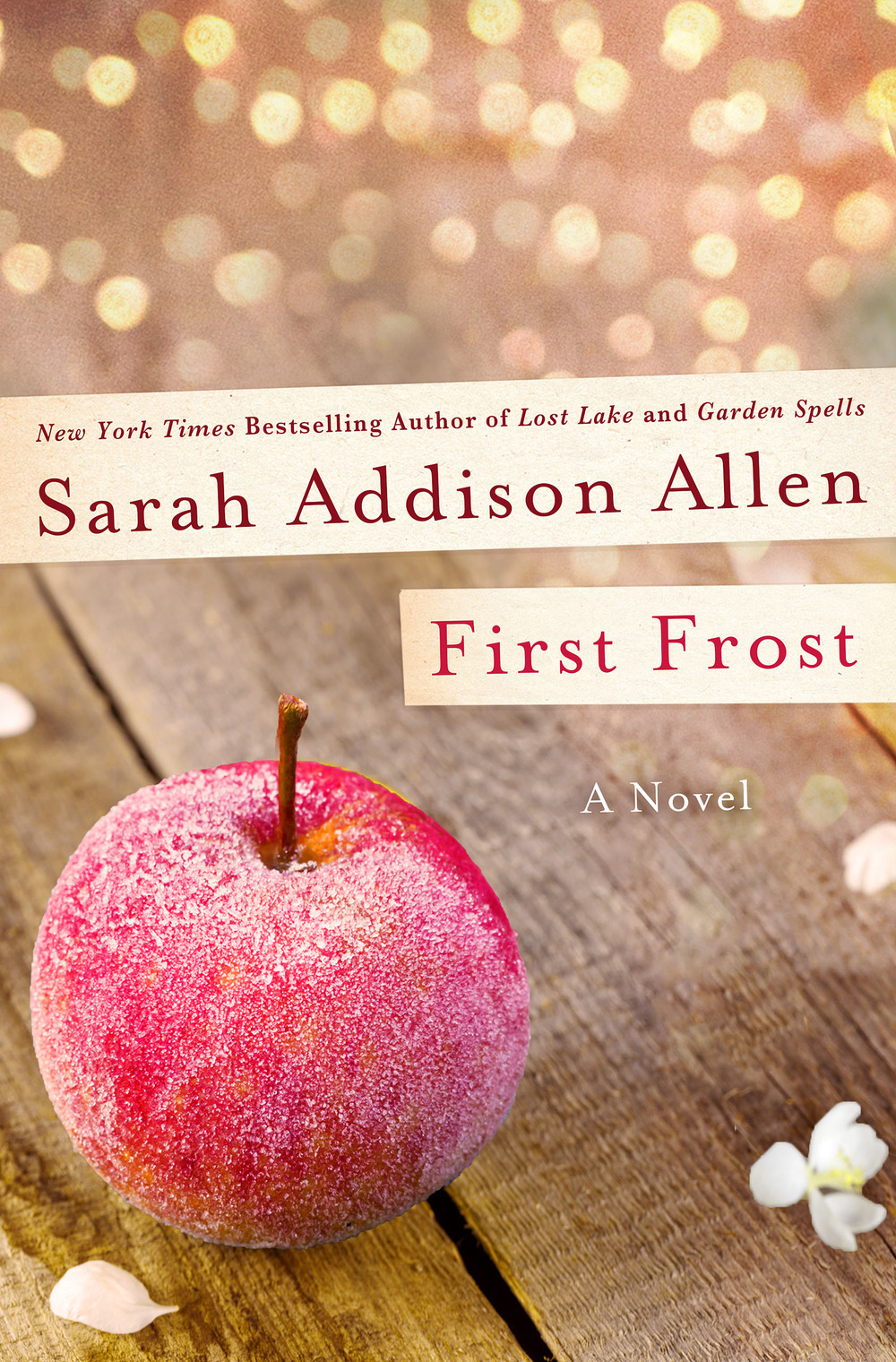 First Frost (2015) by Sarah Addison Allen was a lovely, uplifting sequel to Garden Spells (see my review of that book here). A heartwarming tale of belonging and families and relationships, knowing who you are and embracing that. Filled with very likable characters, who were flawed but (mostly) good, this book was an easy, comfortable read.
 I really identified with Sydney's daughter Bay, now a high-school student set apart from her classmates by her different-ness. Though she is not shunned, she still feels 'other' and slightly isolated, knowing what she wants but not knowing how to get it -- while also dealing with the normal issues of growing up.
And even though I was frustrated by the way Sydney handled her receptionist Violet's issues, it was clear that Sydney knew it was frustrating for herself even, which made it much more understandable. (And, not to spoil anything, but I guess it worked out alright in the end...).
Overall, I would highly recommend both Garden Spells and First Frost when you want something that will captivate you without making you think too hard.
“It had taken her a long time to realize that a prison sometimes isn't a prison at all. Sometimes, it's simply a door you assume is locked because you've never tried to open it.”
Keep reading! Beth
Tuesday, May 10, 2016
The Rosie Project by Graeme Simsion
The Rosie Project (2013) by Graeme Simsion was a sweet, surprising story about a man with many idiosyncrasies who struggles with accepting his own limitations in a world that (frustratingly) does not operate in the logical, orderly way he requires.

When I first started this book, I was really worried that the author would mock the main character and use his different-ness as comedic relief. But Don was an incredibly sympathetic character and I enjoyed his story immensely, especially coming from his unusual but understandable perspective. The Rosie of the title was a very interesting and decently complex character, who had her own plot developed outside of being the main love interest in the story -- always appreciated.
I loved that, since the reader was treated to Don's thought process but not Rosie's, he came off as the more likeable character, despite his own social issues contrasted to Rosie's "normal-ness". My only very small complaint is that the ending seemed a little rushed, but then again the point of the story was really about the journey and not the ending, which left the main characters in a satisfying way. To that end, I have waffled about whether or not to read the sequel, The Rosie Effect, since finishing The Rosie Project. I really liked this as a self-contained story and am very reluctant to get into another story that might muddle the waters, so to speak. For now, I was happy to have read this as a very good, heat-warming, stand-alone novel.
When I first started this book, I was really worried that the author would mock the main character and use his different-ness as comedic relief. But Don was an incredibly sympathetic character and I enjoyed his story immensely, especially coming from his unusual but understandable perspective. The Rosie of the title was a very interesting and decently complex character, who had her own plot developed outside of being the main love interest in the story -- always appreciated.
I loved that, since the reader was treated to Don's thought process but not Rosie's, he came off as the more likeable character, despite his own social issues contrasted to Rosie's "normal-ness". My only very small complaint is that the ending seemed a little rushed, but then again the point of the story was really about the journey and not the ending, which left the main characters in a satisfying way. To that end, I have waffled about whether or not to read the sequel, The Rosie Effect, since finishing The Rosie Project. I really liked this as a self-contained story and am very reluctant to get into another story that might muddle the waters, so to speak. For now, I was happy to have read this as a very good, heat-warming, stand-alone novel.
"It was also obvious that Rosie had very poor taste in coffee -- or she had done as I had and ignored the label 'coffee' and was enjoying it as an entirely new beverage. The technique was working brilliantly." (201)Keep reading! Beth
Monday, April 4, 2016
Outlander series #3: Voyager
 Voyager (1994) by Diana Gabaldon is the third book in the Outlander series, also known (to myself as I was reading it) as Outlander: The Pirates of the Caribbean Year.
This was a really wonderful new chapter to the series after the resolution to the Scottish independence storyline from books 1 & 2. This book went in a completely different direction from the previous two, filled with swashbuckling high-seas adventures to go along with all the romance, intrigue, and historical interest. I was very glad of the change of pace, new scenery, and new characters, and for the story to delve into the unknown after following the slightly predictable course of a well-known historical event.
I loved the beginning of this story, when Claire starts exploring the possibility of trying to go back through the stones a third time, and all that entailed in leaving her now-established life behind and going back to the past. I especially liked the planning stages of having period-appropriate clothing made and stocking her supplies -- I often think about things like that myself; if I knew I was going to travel back to a particular time period, what would I bring and how would I prepare?
Though I thought it was a little abrupt how quickly she found Jaime when she went back, their reunion was very sweet and funny. I really liked the sea voyage and their journey around the Caribbean. And I'm glad that they really tied up a particular storyline that I thought had finished in previous books, but was concluded in a very satisfactory way in this book.
Overall, a thrilling continuation that excited me for future books in the series. And for the second season of the TV show, which premiers in a few days! The costumes alone will be gorgeous.
Keep reading! Beth
Monday, February 29, 2016
Carry On by Rainbow Rowell
 Carry On by Rainbow Rowell (2015) is the not-quite-a-sequel follow-up to Rowell's Fangirl (which I loved and have been recommending to so many people!). This spin-off was such an interesting concept: in Fangirl, the main character spent the entire book writing fanfiction for her favorite fantasy series. This is that story she was writing, her version of the last book in a very Harry Potter-esq fantasy series.
I was very impressed by how Rowell managed to write a story that was clearly the final book in the series, but still made sense to read as a stand-alone. I liked that in Fangirl, you saw the writing process and what Cath was going through when she was writing her story, and then we actually get to read the story that we got such tantalizing snippets of before.
Once again, Rowell has written great characters that are flawed but very likeable. You really root for them. This was of course incredibly similar to Harry Potter in basics, but she had plenty of specific details that really set it apart from that series. I especially liked the way she dealt with the rules of the magic in her world. I loved the connection to literature, cliché phrases, and nursery rhymes, and the message that not only do words have power but common phrases have more; the more ingrained in popular culture a phrase is, the more power it has.
Overall, this was an interesting, funny, and magical story for fans and non-fans of fantasy alike! Highly recommended with Fangirl (which is really worth reading first but not totally necessary).
“Sometimes when I’m walking through the dining hall, just saying hello to people, she’ll drag me by my sleeve to hurry me up.Keep reading! Beth
“You have too many friends,” she’ll say.
“I’m pretty sure that’s not possible. And, anyway, I wouldn’t call them all ‘friends.’”
“There are only so many hours in the day, Simon. Two, three people — that’s all any of us have time for.”
“There are more people than that in your immediate family, Penny.”
“I know. It’s a struggle.”
Wednesday, February 10, 2016
Roundtable: Outlander #1-2 by Diana Gabaldon
Time travel into the land of mist and myth
Outlander is very popular here at the DFL; many staff
members have read the books and/or watched the recent TV show, and so it is a
frequent topic of discussion. I watched the show when it first came
out – and loved it – so I've finally decided to dive in to
the books themselves. I'll be offering my thoughts on each book in
the series as I read them through the rest of this year. Today, I’ll start
with the first two books in the series (which to me were really two halves of a
self-contained story), with the additional perspectives of three of my lovely
colleagues.

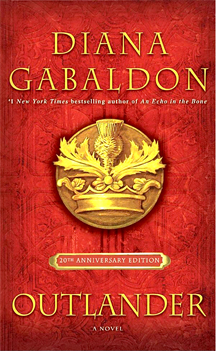
Outlander (1991) and Dragonfly in Amber (1992) together tell
the story of the tail end of the Scottish uprising of the mid-1700s, which
ended with the Battle of Culloden, from the perspective of Claire – a WWII nurse who accidentally travels back in time from 1945 to 1743 Scotland. The books touch upon many
fascinating subjects, both reality – including daily life, health
care, and politics in the 18th century (and even to a certain extent, mid-20th
century) – and fantasy/sci fi, such as: can events in the past ever be
changed, or is history always set in stone? And intertwined throughout is
romance, adventure, and intrigue.
KAREN:
I had heard so much about the Outlander series and always felt
I should read them, but I’ll confess that the thickness of the books made me stay
clear of them for a long time. A couple of summers ago, I caved and started
reading the first one. The TV show was coming out and I wanted the visions in
my head before Hollywood provided them for me. Before I knew it, the end of
August arrived and I had read through the whole series. I was hooked and ready to fly
to Scotland.
Call them romance, historical fiction, fantasy, or adventure
– the series crosses many genres. They
left me wanting to do a little research on the Battle of Culloden and Scottish
history. They left me trying to learn a few words in Gaelic. They left me
wondering what I did with my old kilt and instead of thinking ‘Don’t worry’ I
found myself thinking ‘Dinna fash.’
They also left me wondering if – given the chance –
would I go back in time? Luckily I don’t
have to decide. I can take my 21st century knowledge and live in a Scottish
castle. I can learn about medicinal herbs and sleep on a bed of pine needles,
but I can do it with electricity, and modern medicine . . . and coffee. . . hot
coffee in the morning. I can travel through pages (instead of stones) into the
world of romance, loyalty, and honor created by Diana Gabaldon.
 Give them a try. If you're also intimidated by the
thickness of the books, try the audio. There is nothing like a commute to work while
listening to someone profess their love with a Scottish brogue.
Give them a try. If you're also intimidated by the
thickness of the books, try the audio. There is nothing like a commute to work while
listening to someone profess their love with a Scottish brogue.
SUZANNE:
I really wanted to like Outlander. It has story elements
that I enjoy: a smart and strong female lead, historical fiction, and some
magic. But the story just never drew me in and although I am glad that I read
this, I didn’t actually like it. It even left me confused, and wondering what
about this massively popular story I am not getting.
One common theme that rarely holds my interest is what I
think of as the “Too Many Boyfriends” scenario, which is when lots of male
characters are lusting after the female protagonist, and a love triangle is
part of the main story. I tend to find that dynamic annoying because it seems to
be a lazy way for an author to show the importance of a female protagonist. Claire
has two husbands, both love her eternally and completely, and she’s also
constantly being ogled, commented upon, and pawed by both friendly and
antagonistic male characters.
This was also a more violent story than I was expecting, and
that bothered me. As someone who really enjoys the Song of Ice and Fire series,
I can handle violence in novels. But the violence here was often justified in a
way that made me uncomfortable. Jamie beats Claire at one point and she comes
to forgive him because he explains that he did it out of love for her. Jamie
speaks about the beatings he received from his father as being a sign of love. Claire
and Jamie’s whole relationship in general seems to hinge on the fact the he is
horribly hurt over and over, and she heals him. Throw in some added baby
exposure and bare-handed wolf killing, and it was all too much for me.
There was also an element of gay panic to this story. There
is an ancillary gay character who is predatory with a predilection for
adolescent men, but who is also written off as a buffoon and an object of
ridicule for the other characters. And then, of course, there is Captain
Randall (I won’t say too much – spoilers!). Also, the fact that Captain
Randall looks exactly like Claire’s other husband, Frank, made me wonder what
sort of strange symbolism that was supposed to represent.
So, what am I missing? Why do people love this series? Is it
better as a TV show?
 LINDSEY:
 I enjoyed Outlander far more than I expected to. Romance novels aren’t really my thing, but the historical element drew me to the series (as well as the urging of several coworkers) and I am so glad that I read them.
At first, I was displeased by the “woman loves two men and
has to choose” story arc but Gabaldon made Claire come alive for me and instead
of a torrid love story, I saw a woman doing the best she could under
extraordinary circumstances. I’m going to try to avoid spoilers here but I
really loved how Gabaldon took common themes like abduction, rape, and rescue
and flipped them. This damsel spent as much time rescuing as being rescued and
all characters carried the scars of their encounters. Nothing was easily won or
easily forgotten, which contributed to the depths of the characters and my
attachment to them. Obviously the time comes when Claire must choose between
her two men and I have to admit that I cheered at her choice. In all I was
pulled into this book and taken for a ride that I thoroughly enjoyed.
BETH:
It’s worth noting that Lindsey, Suzanne, and I started
reading #1 together after the first season of the show aired. Lindsey and
Suzanne – neither of whom watched the show before reading the books –
both mentioned that they had a bit of a hard time getting into the story at the
beginning (one of whom ended up really getting into the series, the other didn’t –
I’ll let you guess which is which). But I watched the show first, and had no
trouble getting into the story at all. While I don’t usually recommend watching
a show or movie before reading the book, in this case I can’t help but wonder
if the show helped me get into the book because it was so great. I was impressed once I did read
the book how closely the show stuck to the original story. In fact, there were
quite a few details in which I thought the show even improved the book, specifically
where the it could 'show' something that the book only 'told'.
Overall, I thought that the characters were wonderfully
complex, the setting incredibly interesting, the writing was great, and I
really appreciated that by the end of #2, almost all the different threads brought
up in #1 were resolved, so that none of the specific story lines felt like they
dragged out too much, but rather ended in a very satisfactory manner (which of course left an opening for many other adventures in the rest of the series).
While I too was occasionally bothered by what might have been a little bit too much sexual violence for the sake of sexual violence, I did feel that Gabaldon was trying to make a point about what the reality was like for women in the 18th century (and most of history before and even after that). For most of written history (at least in terms of Western / European history), women have been considered the property of their fathers and husbands, and sadly I think it was more common than not for men to take advantage of this. I thought the books did a good job of expressing how anathema that would be to a modern woman, and really helped immerse my mind in the attitudes of the era.
While I too was occasionally bothered by what might have been a little bit too much sexual violence for the sake of sexual violence, I did feel that Gabaldon was trying to make a point about what the reality was like for women in the 18th century (and most of history before and even after that). For most of written history (at least in terms of Western / European history), women have been considered the property of their fathers and husbands, and sadly I think it was more common than not for men to take advantage of this. I thought the books did a good job of expressing how anathema that would be to a modern woman, and really helped immerse my mind in the attitudes of the era.
At the end, I was very satisfied with the way that this
story (in books #1-2) addressed the fascinating question of whether or not we
can change the past, in both large and small ways. While it makes me sad that time
travel may always remain science fiction, perhaps it’s for the best, and at
least we can always travel to any time period through books, shows, and movies.
And, as Karen pointed out, can do so from the comforts of our own heated, clean
living rooms with a nice cup of tea and some cookies!
Keep reading! Beth
Subscribe to:
Posts (Atom)