Showing posts with label Historical Fiction. Show all posts

Sunday, February 11, 2018

Above Us Only Sky by Michele Young-Stone


Above Us Only Sky (2015) by Michele Young-Stone was a beautiful, emotional book. I loved the relationship between the main character and her grandfather, and the way the story kept referring back to the experience of the grandfather and his family during violent, dangerous times of upheaval when he was a child. 

The conceit -- that the women of this family had a genetic 'gift' of being born with wings (a gift that is of course viewed with suspicion and medical alarm) -- was a lovely one that was woven well into the story without it being the main topic. This wasn't a fantasy book, but rather a fiction book about family and heritage with a fantasy twist (sometimes called magical realism).

I'm excited to read Young-Stone's new book, Lost in the Beehive, coming out this April, which looks like it will focus on friendship and mental health issues with just a twist of magical realism very similarly to Above Us Only Sky.

“I felt guilty because I was upset by the loss of one friend when the Old Man had lost nearly everyone he loved. Loss, I soon learned from him, is not measured in numbers. It's not comparative. It's in here. I'm touching my chest now.”
Keep reading! Beth


Wednesday, May 17, 2017

The Sisters Brothers by Patrick deWitt

Taking inspiration from the craze of the California Gold Rush and the madness it seemed to induce in the general populace and the individuals who participated, The Sisters Brothers (2011) by Patrick deWitt was a very good story from quite a different perspective than the books I typically read.

Wednesday, May 3, 2017

Dominion by C.J. Sansom

Dominion (2012) by C.J. Sansom offers an incredibly important view of World War II and what might have happened if the allies had tried appeasement and compromise instead of fighting back against Hitler. It really made me think a lot about war and what is truly worth fighting for; for every action, both fighting and not fighting, there are always consequences.

Wednesday, April 19, 2017

The Fiery Cross by Diana Gabaldon

The 5th book in Diana Gabaldon's Outlander series, The Fiery Cross (2001) follows immediately after the events of book 4, and therefore maintains both the wonderful writing and interesting characters and settings we've become used to.

Wednesday, March 8, 2017

Dominion by C.J. Sansom

Dominion (2012) by C.J. Sansom was exciting, disturbing, interesting, and -- given current events -- pretty depressing. The story offered an incredibly important view of "what if" the allies had tried appeasement and compromise in relation to Hitler's reign. In not fighting back against the evil, the allies became the evil.

Wednesday, February 15, 2017

The Winter People by Jennifer McMahon

The Winter People (2014) by Jennifer McMahon is a wonderful book filled with excitement, mystery, troubling pasts, anticipation, and just enough of the supernatural (I won't say what kind -- that would give things away) to keep it interesting.

Flipping back and forth between the past and the present, I liked the connection that created, with the story weaving the two time periods together very effectively. The "New England" feel of both the setting and the story was very appealing and familiar to me as a life-long (and proud) New Englander myself.

Though the book has supernatural elements, the story was really more about loss and the relationships between mothers and daughters, both with good and especially with not-so-good associations, so don't let the idea of the supernatural turn you off if that's not normally your 'thing'. This is an excellent book to read in poor weather in a cozy chair with a hot drink. A perfect winter book (as the title implies)!

“I think people see what they want to see... But think about it: if you'd lost someone you love, wouldn't you give almost anything to have the chance to see them again?” 

Keep reading! Beth

Wednesday, December 7, 2016

Falling From Horses by Molly Gloss

Falling From Horses (2014) by Molly Gloss is a somewhat sad, disturbing story about Hollywood cowboy films in the 30s in which not very much good happens to any of the characters. Written as a memoir of someone well-known, who interacted with other well-known people -- even though (as far as I know) it's all fictional and none of the characters in the book are real (aside from a couple of real actors from the time who are mentioned only in passing and by name only) -- the structure of the story made it an interesting read, and made up slightly for the fact that there was more telling than showing in the prose.

The story jumped back and forth between different time periods, and I liked that the 'present' of the story (still a flashback) was told in the first person and the further back flashbacks in third person, which made it slightly easier to keep track of the jumps.

Though overall I think this was a good book that was worth reading, I will note that it is definitely NOT for anyone who gets upset about descriptions of animals being mistreated. I really appreciated that the story didn't gloss over the realities of the way animals were treated in the film industry before protective legislation was passed, but I still found many scenes very tough to read.

The subject matter was certainly a time and place I have not read much about before, and the beauty of stories such as this is that they transport us into their unfamiliar environments, good or bad.

Keep reading! Beth

Wednesday, September 28, 2016

The Last Bookaneer by Matthew Pearl

The Last Bookaneer (2015) by Matthew Pearl is a very interesting book with a great concept that didn't quite live up to the thrilling precedent set by Pearl's previous books I've read -- but was an enjoyable read just the same.

I like books and pirates are pretty cool, so the idea of book pirates has a lot going for it, which is why I originally picked up this book (that, and I really loved The Technologists and The Dante Club). While there was certainly plenty of action in this book, I think it wasn't quite at the level of his previous books mostly because of the narrative structure -- as most of the story is told via a character reminiscing, there is less at stake. You of course know right away that the narrator lives through the story since he is telling it! And there was a little bit less overall character development than I would have liked.

But the setting was lovely (I liked the contrast between Europe and the tropics) and the combination of books, legal quagmires, adventure, sea travel, and famous authors made it a fun read. And I certainly appreciated the extent to which books themselves were honored by many of the characters in the story.

At the end, I was glad to have read the book -- it was a good story, it just maybe wasn't what I was expecting based on his other books. This was much more in the category of adventure fiction, rather than literary thriller. Overall, pretty good.

“Strangers talking over piles of books do not remain strangers for long.” (p. 22) 
“Authors do not create literature; they are consumed by it. As a bookseller, I am often asked if I didn’t dream of being an author, but I should rather think it is the author who learns to dream of becoming a bookseller. I do not seek the mantle of genius. I am an appreciator, an observer, a preposition, and content in that, and that is me in a nutshell.” (p. 90)

Keep reading! Beth

Monday, August 22, 2016

The Drums of Autumn (Outlander series #4)

The Drums of Autumn (1996) by Diana Gabaldon is yet another wonderful addition to this gripping series of time travel, romance, and family - and some violence and revenge.

After the wonderful "Pirates of the Caribbean" plot that encompassed book #3 (see my review of that book here, and a staff roundtable review of books #1-2 here), Jaime and Claire are firmly settled in the New World, and so this book was filled with exciting stories of colonizing the American South in the mid-1700s.

I absolutely loved the framework of exploring and pioneering, especially setting up a homestead from scratch with almost nothing but bare hands and force of will. I really loved the slow, day-to-day scenes in the book, the small bits about putting up food and building structures. This is a period of time that has always fascinated me since my childhood obsession with the Little House books, and I was glad to have reminders of that in this (much more adult) series. One of the things I like best about historical fiction is the insight it gives readers into how people lived in a particular place and time, not just the big events that everyone learns about in school.

And, without giving too much away, there was quite a lot that happened in the book that surprised me, especially the storyline with Bree and Roger, and the plot with Ian. His story especially was part of the reason I could not put the book down in the second half - I just had to know what was going to happen with him!

One of my only complaints is how much Fergus has been pushed to the sidelines now that he's set up with his own family. I really like him -- indeed, he was perhaps my favorite character in books #2-3 -- and hope he becomes a more central character in the future (though not, I suppose, if that must come at the expense of his family!)
“Forgiveness is not a single act, but a matter of constant practice”
Keep reading! Beth

Friday, April 22, 2016

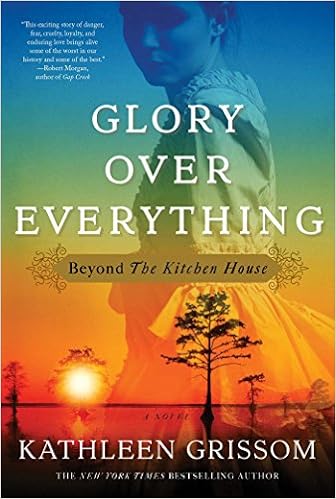
Glory Over Everything by Kathleen Grissom

Glory Over Everything: Beyond the Kitchen House (2016) by Kathleen Grissom is the long-awaited sequel to her 2010 debut, The Kitchen House. I loved the original (read my review here), and am so happy that she continued the story!

Grissom continues to demonstrate a fantastic ability to write characters that you connect with immediately, which was one of the things I was so impressed by in her first book. And in this case specifically, she took a character (James) who was not particularly likeable in The Kitchen House as a child, and gave him such depth that you couldn't help but feel for him in this book. Even though he was anything but perfect, his actions were so understandable and... human... that even if you saw the mistake and its inevitable consequences coming, you get why he did what he did.

Some of the other characters were slightly less understandable -- namely Pan, who made such a wilful, obvious mistake that it was hard to do anything but shake your head at him. But still, he was such an endearing, sincere kid that you felt for him and desperately wanted him to be safe.

And Robert, James's resourceful and unflaggingly loyal butler, was the true hero of the story, swooping in and out with just the right word and idea at key points. I loved his composure and grace, though I liked to imagine that there was a good bit of snark behind that stoic exterior.

This was such a wonderful story, I'm sure this review won't do it justice. Though it started off in a little bit of a disjointed manner, the flashbacks come fairly early on in the book and really provide a complete picture. It was a thrilling page-turner, a heart-pounding look into the Underground Railroad, filled with characters I was truly invested in. You could certainly read it as a stand-alone without much confusion, but I would urge you to read both together -- they are truly worth it! Hopefully the story will continue within the next six years (hint, hint Kathleen...).

Keep reading! Beth

Monday, April 4, 2016

Outlander series #3: Voyager

Voyager (1994) by Diana Gabaldon is the third book in the Outlander series, also known (to myself as I was reading it) as Outlander: The Pirates of the Caribbean Year.

This was a really wonderful new chapter to the series after the resolution to the Scottish independence storyline from books 1 & 2. This book went in a completely different direction from the previous two, filled with swashbuckling high-seas adventures to go along with all the romance, intrigue, and historical interest. I was very glad of the change of pace, new scenery, and new characters, and for the story to delve into the unknown after following the slightly predictable course of a well-known historical event.

I loved the beginning of this story, when Claire starts exploring the possibility of trying to go back through the stones a third time, and all that entailed in leaving her now-established life behind and going back to the past. I especially liked the planning stages of having period-appropriate clothing made and stocking her supplies -- I often think about things like that myself; if I knew I was going to travel back to a particular time period, what would I bring and how would I prepare?

Though I thought it was a little abrupt how quickly she found Jaime when she went back, their reunion was very sweet and funny. I really liked the sea voyage and their journey around the Caribbean. And I'm glad that they really tied up a particular storyline that I thought had finished in previous books, but was concluded in a very satisfactory way in this book.

Overall, a thrilling continuation that excited me for future books in the series. And for the second season of the TV show, which premiers in a few days! The costumes alone will be gorgeous.

Keep reading! Beth

Wednesday, February 10, 2016

Roundtable: Outlander #1-2 by Diana Gabaldon


Time travel into the land of mist and myth

Outlander is very popular here at the DFL; many staff members have read the books and/or watched the recent TV show, and so it is a frequent topic of discussion. I watched the show when it first came out – and loved it – so I've finally decided to dive in to the books themselves. I'll be offering my thoughts on each book in the series as I read them through the rest of this year. Today, I’ll start with the first two books in the series (which to me were really two halves of a self-contained story), with the additional perspectives of three of my lovely colleagues. 


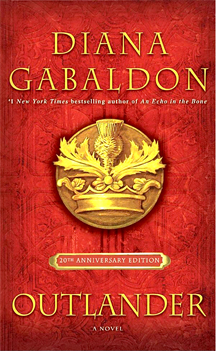
Outlander (1991) and Dragonfly in Amber (1992) together tell the story of the tail end of the Scottish uprising of the mid-1700s, which ended with the Battle of Culloden, from the perspective of Claire – a WWII nurse who accidentally travels back in time from 1945 to 1743 Scotland. The books touch upon many fascinating subjects, both reality – including daily life, health care, and politics in the 18th century (and even to a certain extent, mid-20th century) – and fantasy/sci fi, such as: can events in the past ever be changed, or is history always set in stone? And intertwined throughout is romance, adventure, and intrigue.

KAREN:
I had heard so much about the Outlander series and always felt I should read them, but I’ll confess that the thickness of the books made me stay clear of them for a long time. A couple of summers ago, I caved and started reading the first one. The TV show was coming out and I wanted the visions in my head before Hollywood provided them for me. Before I knew it, the end of August arrived and I had read through the whole series. I was hooked and ready to fly to Scotland.

Call them romance, historical fiction, fantasy, or adventure – the series crosses many genres.  They left me wanting to do a little research on the Battle of Culloden and Scottish history. They left me trying to learn a few words in Gaelic. They left me wondering what I did with my old kilt and instead of thinking ‘Don’t worry’ I found myself thinking ‘Dinna fash.’

They also left me wondering if – given the chance – would I go back in time?  Luckily I don’t have to decide. I can take my 21st century knowledge and live in a Scottish castle. I can learn about medicinal herbs and sleep on a bed of pine needles, but I can do it with electricity, and modern medicine . . . and coffee. . . hot coffee in the morning. I can travel through pages (instead of stones) into the world of romance, loyalty, and honor created by Diana Gabaldon.

Give them a try. If you're also intimidated by the thickness of the books, try the audio. There is nothing like a commute to work while listening to someone profess their love with a Scottish brogue.

SUZANNE:
I really wanted to like Outlander. It has story elements that I enjoy: a smart and strong female lead, historical fiction, and some magic. But the story just never drew me in and although I am glad that I read this, I didn’t actually like it. It even left me confused, and wondering what about this massively popular story I am not getting.

One common theme that rarely holds my interest is what I think of as the “Too Many Boyfriends” scenario, which is when lots of male characters are lusting after the female protagonist, and a love triangle is part of the main story. I tend to find that dynamic annoying because it seems to be a lazy way for an author to show the importance of a female protagonist. Claire has two husbands, both love her eternally and completely, and she’s also constantly being ogled, commented upon, and pawed by both friendly and antagonistic male characters.

This was also a more violent story than I was expecting, and that bothered me. As someone who really enjoys the Song of Ice and Fire series, I can handle violence in novels. But the violence here was often justified in a way that made me uncomfortable. Jamie beats Claire at one point and she comes to forgive him because he explains that he did it out of love for her. Jamie speaks about the beatings he received from his father as being a sign of love. Claire and Jamie’s whole relationship in general seems to hinge on the fact the he is horribly hurt over and over, and she heals him. Throw in some added baby exposure and bare-handed wolf killing, and it was all too much for me.

There was also an element of gay panic to this story. There is an ancillary gay character who is predatory with a predilection for adolescent men, but who is also written off as a buffoon and an object of ridicule for the other characters. And then, of course, there is Captain Randall (I won’t say too much – spoilers!). Also, the fact that Captain Randall looks exactly like Claire’s other husband, Frank, made me wonder what sort of strange symbolism that was supposed to represent.

So, what am I missing? Why do people love this series? Is it better as a TV show?

LINDSEY:
I enjoyed Outlander far more than I expected to. Romance novels aren’t really my thing, but the historical element drew me to the series (as well as the urging of several coworkers) and I am so glad that I read them.

At first, I was displeased by the “woman loves two men and has to choose” story arc but Gabaldon made Claire come alive for me and instead of a torrid love story, I saw a woman doing the best she could under extraordinary circumstances. I’m going to try to avoid spoilers here but I really loved how Gabaldon took common themes like abduction, rape, and rescue and flipped them. This damsel spent as much time rescuing as being rescued and all characters carried the scars of their encounters. Nothing was easily won or easily forgotten, which contributed to the depths of the characters and my attachment to them. Obviously the time comes when Claire must choose between her two men and I have to admit that I cheered at her choice. In all I was pulled into this book and taken for a ride that I thoroughly enjoyed.

BETH:
It’s worth noting that Lindsey, Suzanne, and I started reading #1 together after the first season of the show aired. Lindsey and Suzanne – neither of whom watched the show before reading the books – both mentioned that they had a bit of a hard time getting into the story at the beginning (one of whom ended up really getting into the series, the other didn’t – I’ll let you guess which is which). But I watched the show first, and had no trouble getting into the story at all. While I don’t usually recommend watching a show or movie before reading the book, in this case I can’t help but wonder if the show helped me get into the book because it was so great. I was impressed once I did read the book how closely the show stuck to the original story. In fact, there were quite a few details in which I thought the show even improved the book, specifically where the it could 'show' something that the book only 'told'.

Overall, I thought that the characters were wonderfully complex, the setting incredibly interesting, the writing was great, and I really appreciated that by the end of #2, almost all the different threads brought up in #1 were resolved, so that none of the specific story lines felt like they dragged out too much, but rather ended in a very satisfactory manner (which of course left an opening for many other adventures in the rest of the series).

While I too was occasionally bothered by what might have been a little bit too much sexual violence for the sake of sexual violence, I did feel that Gabaldon was trying to make a point about what the reality was like for women in the 18th century (and most of history before and even after that). For most of written history (at least in terms of Western / European history), women have been considered the property of their fathers and husbands, and sadly I think it was more common than not for men to take advantage of this. I thought the books did a good job of expressing how anathema that would be to a modern woman, and really helped immerse my mind in the attitudes of the era.

At the end, I was very satisfied with the way that this story (in books #1-2) addressed the fascinating question of whether or not we can change the past, in both large and small ways. While it makes me sad that time travel may always remain science fiction, perhaps it’s for the best, and at least we can always travel to any time period through books, shows, and movies. And, as Karen pointed out, can do so from the comforts of our own heated, clean living rooms with a nice cup of tea and some cookies!

Keep reading! Beth

Monday, September 14, 2015

Summer Reading Highlights, Part 3: Jane Austen Spin-Offs – Longbourn and Death Comes to Pemberley


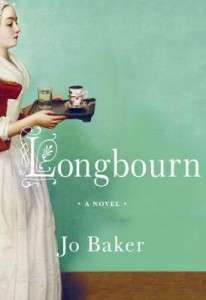
This book takes place alongside the events of Pride and Prejudice, this time from the perspective of the servants who tend to the Longbourn estate and the Bennet family. In keeping with great TV shows such as Downton Abbey and Upstairs Downstairs, the stories of the ‘downstairs’ residents of great English houses really completes the picture of what life really was like in the 1800-1900s.

There were far more Sarahs and Pollys than there were Elizabeth Bennets in the Georgian and Regency eras, and their ways of life are often overlooked in favor of the flashier upper class. Of course servants of grand houses were in much better positions themselves than a great number of English citizens, as demonstrated by the high desirability of such jobs. My favorite part of historical fiction is developing a greater understanding of how people lived in different places and times, and this story fits the bill nicely, while also fleshing out a classic story!


This story is a direct sequel to Austen’s classic, picking up the story of Elizabeth and Darcy a few years after their wedding at the end of Pride and Prejudice, and adding in a juicy mystery to boot! I have been a great fan of sequels and series since I was a child, always appreciating the continuation of a story for characters I have grown to care about, and this book doesn’t disappoint in that respect.

I loved reading about (one possible version) of Elizabeth’s life at Pemberley as a wife and mother, with almost all of the Bennets making an appearance. The framework of a mystery was much more interesting to me than the simple romances that other Austen sequels seem to feature (though this is the first I’ve read, so I shouldn’t judge until I’ve tried the others out), though I might have appreciated a story much more centered around Elizabeth and Darcy than Wickham and Lydia. But that slight detail didn’t keep me from really enjoying this book.

I wish James had written more before she sadly passed away last year.

(Also, the BBC miniseries based on the book was great, and very close to the book!)

What are your favorite historical novels? 

Keep reading! Beth

Tuesday, September 8, 2015

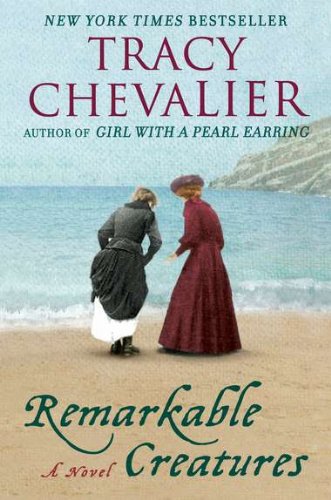
Summer Reading Highlights, Part 2: Historical Fiction ­– The Kitchen House and Remarkable Creatures


This book started off a little slow, but picked up really quickly until I found myself not being able to put it down. Debut author Kathleen Grissom really knows how to write characters that you care about, root for, and feel for. Taking place at the height of the slave era in the south, the story was a unique window into both sides of plantation life, with the main character Lavinia often times uncomfortably straddling the inter-dependent worlds of landowners and slaves. Though the story was filled with lots of heartbreak and tense situations, the heartwarming relationships, especially between Lavinia and Mama Mae, were uplifting.

The ending was a satisfying conclusion to the story (I dislike endings that are too vague or open-ended), while still leaving the possibility for much more story yet to come. I wish she would write a sequel! But I’m trying to be respectful of the author and her creative process as I anxiously await her second book (which of course may or may not be a sequel), so many years after The Kitchen House was released.


As a devoted Anglophile, any story that takes place in England (or anywhere in the UK really) is practically guaranteed to interest me. This one was of particular interest because – as I discovered part-way through the book – the story is based on real people.

The main character, Mary Anning, was a poor girl from a working class family who lived during the Regency and Victorian Eras. Decades before Charles Darwin made his discoveries on evolution, she became a notable fossil hunter as she scoured the beaches of her hometown on the south coast of England. Despite not knowing exactly what she was finding, she succeeded in (almost) turning both the religious and scientific communities on their heads with her fossils of long-extinct creatures.


I love reading about strong women who lead interesting lives, and this one certainly fit the bill!

Keep reading! Beth