Though clearly written by someone who is not a 'writer', The Shepherd's Life: Modern Dispatches from an Ancient Landscape (2015) by James Rebanks was a compelling book about a lifestyle that hasn't changed much in centuries.
Showing posts with label England. Show all posts
Showing posts with label England. Show all posts
Wednesday, June 7, 2017

Wednesday, May 3, 2017
Dominion by C.J. Sansom
 Dominion (2012) by C.J. Sansom offers an incredibly important view of World War II and what might have happened if the allies had tried appeasement and compromise instead of fighting back against Hitler. It really made me think a lot about war and what is truly worth fighting for; for every action, both fighting and not fighting, there are always consequences.
 Wednesday, March 8, 2017
Dominion by C.J. Sansom
Dominion (2012) by C.J. Sansom was exciting, disturbing, interesting, and -- given current events -- pretty depressing. The story offered an incredibly important view of "what if" the allies had tried appeasement and compromise in relation to Hitler's reign. In not fighting back against the evil, the allies became the evil.
Wednesday, December 21, 2016
The Owl Who Liked Sitting on Caesar by Martin Windrow
The Owl Who Liked Sitting on Caesar: Living with a Tawny Owl (2014) by Martin Windrow was a sweet book about an rather unusual (though at the same time so stereotypically British) relationship between a man and his owl.
 It was truly fascinating to read about the habits of owls and how they did (and, in many ways did not) fit in with human habitation. Windrow made abundantly clear that he respected that owls, even owls that have been hatched and raised by humans, are still wild animals. In most cases, by adjusting his own habits and expectations to fit in with living with the owl rather than expecting the owl to do so. In short, he was never under the illusion that he could fully domesticate her to live as a pet but rather worked very hard to make co-habitation work.
While I loved the relationship between Martin and Mumble, he also very effectively dissuaded me from ever wanting to live with an owl myself -- issues with excrement alone would be a deal-breaker!
I won't spoil the ending by commenting on that, but at the end I was very glad to have read this short, interesting, funny book.
Keep reading! Beth
It was truly fascinating to read about the habits of owls and how they did (and, in many ways did not) fit in with human habitation. Windrow made abundantly clear that he respected that owls, even owls that have been hatched and raised by humans, are still wild animals. In most cases, by adjusting his own habits and expectations to fit in with living with the owl rather than expecting the owl to do so. In short, he was never under the illusion that he could fully domesticate her to live as a pet but rather worked very hard to make co-habitation work.While I loved the relationship between Martin and Mumble, he also very effectively dissuaded me from ever wanting to live with an owl myself -- issues with excrement alone would be a deal-breaker!
I won't spoil the ending by commenting on that, but at the end I was very glad to have read this short, interesting, funny book.
Perched on the back of a sunlit chair was something about 9 inches tall and shaped rather like a plump toy penguin with a nose-job. It appeared to be wearing a one-piece knitted jumpsuit of pale grey fluff with brown stitching, complete with an attached balaclava helmet. From the face-hole of the fuzzy balaclava, two big, shiny black eyes gazed up at me trustfully. 'Kweep', it said quietly. Enchanted, I leaned closer. It blinked its furry grey eyelids, then jumped very deliberately up on to my right shoulder. It felt like a big, warm dandelion head against my cheek, and it smelt like a milky new kitten. 'Kweep', it repeated, very softly.
[...]
Love at first sight – when it hits you late, it hits hard. It hit me at thirty-four, and I was a slave to it for the next fifteen years.
Keep reading! Beth
Wednesday, September 28, 2016
The Last Bookaneer by Matthew Pearl
 The Last Bookaneer (2015) by Matthew Pearl is a very interesting book with a great concept that didn't quite live up to the thrilling precedent set by Pearl's previous books I've read -- but was an enjoyable read just the same.
I like books and pirates are pretty cool, so the idea of book pirates has a lot going for it, which is why I originally picked up this book (that, and I really loved The Technologists and The Dante Club). While there was certainly plenty of action in this book, I think it wasn't quite at the level of his previous books mostly because of the narrative structure -- as most of the story is told via a character reminiscing, there is less at stake. You of course know right away that the narrator lives through the story since he is telling it! And there was a little bit less overall character development than I would have liked.
But the setting was lovely (I liked the contrast between Europe and the tropics) and the combination of books, legal quagmires, adventure, sea travel, and famous authors made it a fun read. And I certainly appreciated the extent to which books themselves were honored by many of the characters in the story.
At the end, I was glad to have read the book -- it was a good story, it just maybe wasn't what I was expecting based on his other books. This was much more in the category of adventure fiction, rather than literary thriller. Overall, pretty good.
“Strangers talking over piles of books do not remain strangers for long.” (p. 22)
“Authors do not create literature; they are consumed by it. As a bookseller, I am often asked if I didn’t dream of being an author, but I should rather think it is the author who learns to dream of becoming a bookseller. I do not seek the mantle of genius. I am an appreciator, an observer, a preposition, and content in that, and that is me in a nutshell.” (p. 90)
Keep reading! Beth
Monday, July 25, 2016
The Woman in Blue by Elly Griffiths
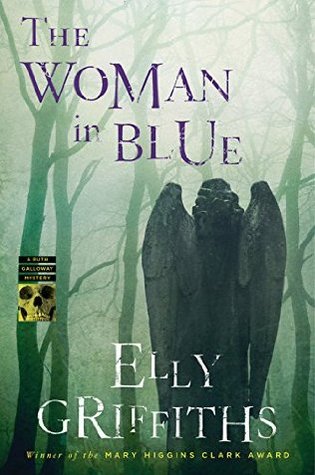 Finally catching up with Elly Griffiths' Ruth Galloway series with the latest entry, #8 - The Woman in Blue (2016).
Cathbad is back, and in top form! So good to see him back at the center of things relating to the mystery, though I'm somewhat disappointed that, while on maternity leave, Judy's character has been relegated to that of Cathbad's partner and mother of his new baby. Hopefully by the next book she'll be back on the force and see some real action.
The mystery itself was interesting; I like way Griffiths integrates different religious, pagan, and secular ways of thinking into many of her stories in a relatively equal way. I am inclined to believe that her personal beliefs run closest toward Ruth's own (as the main character), yet other characters (such as Cathbad and Father Hennessey) present a sympathetic view of other ways of thinking.
Overall, a nice continuation for a series that has really settled on a comfortable pattern, with the pros and cons that entails. I think you really know what you're getting with a Ruth Galloway mystery at this point, which is okay by me. Looking forward to the next one, which is expected sometime early 2017.
See my reviews of book 1, books 2-4, and books 5-7 posted earlier on this blog.
Keep reading! Beth
Tuesday, June 7, 2016
Ruth Galloway mystery series #5-7
Elly Griffiths continues her wonderful Ruth Galloway series in books 5-7, in which Ruth continues to solve crimes, inadvertently place herself in mortal danger, and struggle with her personal relationships in a rather endearing way. (See my review of book #1 of the series here, and books #2-4 here.)
#5: Dying Fall (2013)
 Yet another great entry in the series. I loved that Cathbad was a greater part of this story; we really got to know him better. And some additional insight into Nelson's character, being back in his hometown. Otherwise, it was a little silly that - having been in situations of mortal peril at least 3 times previously - Ruth still decides to go check out these bones with her daughter after getting threatening texts. Slightly unbelievable, but I guess it's good for the main character to have flaws and make bad decisions - it would be hard to really connect with her if she was perfect.

#6: The Outcast Dead (2014)
The story in this one had a great sub-plot that really developed Judy's character especially. I'm very glad Tim has joined the team; I really like him. And so glad Cathbad has been given a reason and allowance to come back! Though I found his daughter, Maddie's, involvement in the case suspicious, it was nice to 'see' her again. And the way that the police case and the goings-on in Ruth's life intersected without Ruth officially working on the case was great and more realistic than Ruth officially consulting on every issue that comes to the police.
#7: The Ghost Fields (2015)
 It was -- interesting, I guess? -- that Nelson's wife Michelle got her own storyline in this book. I won't spoil too much by saying what this story was or my specific reaction to it, but regardless of what actually happened, I liked that she was given some additional character development outside of Nelson and Ruth. And I liked the way that Griffiths plays with suspicious of various characters, keeping you on your toes.
And that's me finally caught up on the Ruth Galloway series, just in time for the publication of book #8, The Woman in Blue, which came out May 3rd. Going to jump right into that one!
Keep reading! Beth
#5: Dying Fall (2013)
Yet another great entry in the series. I loved that Cathbad was a greater part of this story; we really got to know him better. And some additional insight into Nelson's character, being back in his hometown. Otherwise, it was a little silly that - having been in situations of mortal peril at least 3 times previously - Ruth still decides to go check out these bones with her daughter after getting threatening texts. Slightly unbelievable, but I guess it's good for the main character to have flaws and make bad decisions - it would be hard to really connect with her if she was perfect."'You need a break, a complete rest, recharge your batteries.' Recharge you batteries. What the hell does that mean? Nelson prides himself on not needing batteries. He's an old-fashioned, wind up model." (p. 21)
#6: The Outcast Dead (2014)
The story in this one had a great sub-plot that really developed Judy's character especially. I'm very glad Tim has joined the team; I really like him. And so glad Cathbad has been given a reason and allowance to come back! Though I found his daughter, Maddie's, involvement in the case suspicious, it was nice to 'see' her again. And the way that the police case and the goings-on in Ruth's life intersected without Ruth officially working on the case was great and more realistic than Ruth officially consulting on every issue that comes to the police.
#7: The Ghost Fields (2015)
 It was -- interesting, I guess? -- that Nelson's wife Michelle got her own storyline in this book. I won't spoil too much by saying what this story was or my specific reaction to it, but regardless of what actually happened, I liked that she was given some additional character development outside of Nelson and Ruth. And I liked the way that Griffiths plays with suspicious of various characters, keeping you on your toes.
And that's me finally caught up on the Ruth Galloway series, just in time for the publication of book #8, The Woman in Blue, which came out May 3rd. Going to jump right into that one!
Keep reading! Beth
Monday, February 29, 2016
Carry On by Rainbow Rowell
 Carry On by Rainbow Rowell (2015) is the not-quite-a-sequel follow-up to Rowell's Fangirl (which I loved and have been recommending to so many people!). This spin-off was such an interesting concept: in Fangirl, the main character spent the entire book writing fanfiction for her favorite fantasy series. This is that story she was writing, her version of the last book in a very Harry Potter-esq fantasy series.
I was very impressed by how Rowell managed to write a story that was clearly the final book in the series, but still made sense to read as a stand-alone. I liked that in Fangirl, you saw the writing process and what Cath was going through when she was writing her story, and then we actually get to read the story that we got such tantalizing snippets of before.
Once again, Rowell has written great characters that are flawed but very likeable. You really root for them. This was of course incredibly similar to Harry Potter in basics, but she had plenty of specific details that really set it apart from that series. I especially liked the way she dealt with the rules of the magic in her world. I loved the connection to literature, cliché phrases, and nursery rhymes, and the message that not only do words have power but common phrases have more; the more ingrained in popular culture a phrase is, the more power it has.
Overall, this was an interesting, funny, and magical story for fans and non-fans of fantasy alike! Highly recommended with Fangirl (which is really worth reading first but not totally necessary).
“Sometimes when I’m walking through the dining hall, just saying hello to people, she’ll drag me by my sleeve to hurry me up.Keep reading! Beth
“You have too many friends,” she’ll say.
“I’m pretty sure that’s not possible. And, anyway, I wouldn’t call them all ‘friends.’”
“There are only so many hours in the day, Simon. Two, three people — that’s all any of us have time for.”
“There are more people than that in your immediate family, Penny.”
“I know. It’s a struggle.”
Wednesday, February 10, 2016
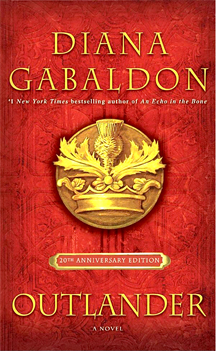
Roundtable: Outlander #1-2 by Diana Gabaldon
Time travel into the land of mist and myth
Outlander is very popular here at the DFL; many staff
members have read the books and/or watched the recent TV show, and so it is a
frequent topic of discussion. I watched the show when it first came
out – and loved it – so I've finally decided to dive in to
the books themselves. I'll be offering my thoughts on each book in
the series as I read them through the rest of this year. Today, I’ll start
with the first two books in the series (which to me were really two halves of a
self-contained story), with the additional perspectives of three of my lovely
colleagues.

Outlander (1991) and Dragonfly in Amber (1992) together tell
the story of the tail end of the Scottish uprising of the mid-1700s, which
ended with the Battle of Culloden, from the perspective of Claire – a WWII nurse who accidentally travels back in time from 1945 to 1743 Scotland. The books touch upon many
fascinating subjects, both reality – including daily life, health
care, and politics in the 18th century (and even to a certain extent, mid-20th
century) – and fantasy/sci fi, such as: can events in the past ever be
changed, or is history always set in stone? And intertwined throughout is
romance, adventure, and intrigue.
KAREN:
I had heard so much about the Outlander series and always felt
I should read them, but I’ll confess that the thickness of the books made me stay
clear of them for a long time. A couple of summers ago, I caved and started
reading the first one. The TV show was coming out and I wanted the visions in
my head before Hollywood provided them for me. Before I knew it, the end of
August arrived and I had read through the whole series. I was hooked and ready to fly
to Scotland.
Call them romance, historical fiction, fantasy, or adventure
– the series crosses many genres. They
left me wanting to do a little research on the Battle of Culloden and Scottish
history. They left me trying to learn a few words in Gaelic. They left me
wondering what I did with my old kilt and instead of thinking ‘Don’t worry’ I
found myself thinking ‘Dinna fash.’
They also left me wondering if – given the chance –
would I go back in time? Luckily I don’t
have to decide. I can take my 21st century knowledge and live in a Scottish
castle. I can learn about medicinal herbs and sleep on a bed of pine needles,
but I can do it with electricity, and modern medicine . . . and coffee. . . hot
coffee in the morning. I can travel through pages (instead of stones) into the
world of romance, loyalty, and honor created by Diana Gabaldon.
 Give them a try. If you're also intimidated by the
thickness of the books, try the audio. There is nothing like a commute to work while
listening to someone profess their love with a Scottish brogue.
Give them a try. If you're also intimidated by the
thickness of the books, try the audio. There is nothing like a commute to work while
listening to someone profess their love with a Scottish brogue.
SUZANNE:
I really wanted to like Outlander. It has story elements
that I enjoy: a smart and strong female lead, historical fiction, and some
magic. But the story just never drew me in and although I am glad that I read
this, I didn’t actually like it. It even left me confused, and wondering what
about this massively popular story I am not getting.
One common theme that rarely holds my interest is what I
think of as the “Too Many Boyfriends” scenario, which is when lots of male
characters are lusting after the female protagonist, and a love triangle is
part of the main story. I tend to find that dynamic annoying because it seems to
be a lazy way for an author to show the importance of a female protagonist. Claire
has two husbands, both love her eternally and completely, and she’s also
constantly being ogled, commented upon, and pawed by both friendly and
antagonistic male characters.
This was also a more violent story than I was expecting, and
that bothered me. As someone who really enjoys the Song of Ice and Fire series,
I can handle violence in novels. But the violence here was often justified in a
way that made me uncomfortable. Jamie beats Claire at one point and she comes
to forgive him because he explains that he did it out of love for her. Jamie
speaks about the beatings he received from his father as being a sign of love. Claire
and Jamie’s whole relationship in general seems to hinge on the fact the he is
horribly hurt over and over, and she heals him. Throw in some added baby
exposure and bare-handed wolf killing, and it was all too much for me.
There was also an element of gay panic to this story. There
is an ancillary gay character who is predatory with a predilection for
adolescent men, but who is also written off as a buffoon and an object of
ridicule for the other characters. And then, of course, there is Captain
Randall (I won’t say too much – spoilers!). Also, the fact that Captain
Randall looks exactly like Claire’s other husband, Frank, made me wonder what
sort of strange symbolism that was supposed to represent.
So, what am I missing? Why do people love this series? Is it
better as a TV show?
 LINDSEY:
 I enjoyed Outlander far more than I expected to. Romance novels aren’t really my thing, but the historical element drew me to the series (as well as the urging of several coworkers) and I am so glad that I read them.
At first, I was displeased by the “woman loves two men and
has to choose” story arc but Gabaldon made Claire come alive for me and instead
of a torrid love story, I saw a woman doing the best she could under
extraordinary circumstances. I’m going to try to avoid spoilers here but I
really loved how Gabaldon took common themes like abduction, rape, and rescue
and flipped them. This damsel spent as much time rescuing as being rescued and
all characters carried the scars of their encounters. Nothing was easily won or
easily forgotten, which contributed to the depths of the characters and my
attachment to them. Obviously the time comes when Claire must choose between
her two men and I have to admit that I cheered at her choice. In all I was
pulled into this book and taken for a ride that I thoroughly enjoyed.
BETH:
It’s worth noting that Lindsey, Suzanne, and I started
reading #1 together after the first season of the show aired. Lindsey and
Suzanne – neither of whom watched the show before reading the books –
both mentioned that they had a bit of a hard time getting into the story at the
beginning (one of whom ended up really getting into the series, the other didn’t –
I’ll let you guess which is which). But I watched the show first, and had no
trouble getting into the story at all. While I don’t usually recommend watching
a show or movie before reading the book, in this case I can’t help but wonder
if the show helped me get into the book because it was so great. I was impressed once I did read
the book how closely the show stuck to the original story. In fact, there were
quite a few details in which I thought the show even improved the book, specifically
where the it could 'show' something that the book only 'told'.
Overall, I thought that the characters were wonderfully
complex, the setting incredibly interesting, the writing was great, and I
really appreciated that by the end of #2, almost all the different threads brought
up in #1 were resolved, so that none of the specific story lines felt like they
dragged out too much, but rather ended in a very satisfactory manner (which of course left an opening for many other adventures in the rest of the series).
While I too was occasionally bothered by what might have been a little bit too much sexual violence for the sake of sexual violence, I did feel that Gabaldon was trying to make a point about what the reality was like for women in the 18th century (and most of history before and even after that). For most of written history (at least in terms of Western / European history), women have been considered the property of their fathers and husbands, and sadly I think it was more common than not for men to take advantage of this. I thought the books did a good job of expressing how anathema that would be to a modern woman, and really helped immerse my mind in the attitudes of the era.
While I too was occasionally bothered by what might have been a little bit too much sexual violence for the sake of sexual violence, I did feel that Gabaldon was trying to make a point about what the reality was like for women in the 18th century (and most of history before and even after that). For most of written history (at least in terms of Western / European history), women have been considered the property of their fathers and husbands, and sadly I think it was more common than not for men to take advantage of this. I thought the books did a good job of expressing how anathema that would be to a modern woman, and really helped immerse my mind in the attitudes of the era.
At the end, I was very satisfied with the way that this
story (in books #1-2) addressed the fascinating question of whether or not we
can change the past, in both large and small ways. While it makes me sad that time
travel may always remain science fiction, perhaps it’s for the best, and at
least we can always travel to any time period through books, shows, and movies.
And, as Karen pointed out, can do so from the comforts of our own heated, clean
living rooms with a nice cup of tea and some cookies!
Keep reading! Beth
Monday, February 1, 2016
Ruth Galloway Series #2-4 by Elly Griffiths
Ruth Galloway mysteries is a series of books written by Elly Griffiths, which center around the life of one (surprise, surprise) Ruth Galloway, a forensic archaeologist who teaches at a university in the Norfolk region of England and occasionally consults with the local police in cases involving unidentified bones. Ruth is a very likable, endearing character who -- despite being the 'heroine' of her own series -- is definitely human enough (and makes enough mistakes) to be truly relatable. I have greatly enjoyed the series so far, and look forward to reading the rest soon!
For my review of the first book in the series, see this post from this past summer.
#2: The Janus Stone (2010)
 I liked how realistic this story was, in the sense that lots of intelligent people contributed to solving the case, rather than one person displaying super-human skills of deduction. I also liked that at the end, though Ruth again was the one who ended up in danger, she saved herself just as much as (or more than) the men who rushed to her rescue.
#3: The House at Sea's End (2011)
One of the great things about this series is the secondary characters, and how they are developing as we get to know them better. Judy (the policewoman) is especially becoming an interesting character, unhappy as she already is in her new marriage. Of course Ruth ends up in mortal peril again in this book, but unlike the previous two books in the series, the ending was a total surprise; I had not guessed at all who the killer was and was totally fooled by all the twists in the story.
#4: A Room Full of Bones (2012)
Though in general, I'm not super thrilled by the whole affair story line developed early in the series, I do like the way Elly is handling the love triangle, and the continued development of the secondary characters. Cathbad especially is such an interesting character -- sometimes a bit too stereotypical, but always intriguing and very charming. I'm interested to see if he continues to be such a constant presence in the cases in future books. It's one of those instances where it feels like a bit of a stretch for him to be involved in every case (a bit along the lines of Ruth's involvement in the first place), but he's a such a great character I hope he sticks around.
The danger for a mystery series with a non-detective in the lead is that sometimes the ways to get the main character involved in each case gets more and more unrealistic. Ruth's involvement is addressed somewhat by her status as an official consultant, and of course there are plenty of local cases that are not mentioned that she has no hand in at all. Still, I hope that the core stories in each book continue to justify her central role in each investigation in a believable manner. Regardless, outside of the case details in each book (which are always interesting), it really is the characters that make these books worth reading.
Keep reading! Beth
For my review of the first book in the series, see this post from this past summer.
#2: The Janus Stone (2010)
 I liked how realistic this story was, in the sense that lots of intelligent people contributed to solving the case, rather than one person displaying super-human skills of deduction. I also liked that at the end, though Ruth again was the one who ended up in danger, she saved herself just as much as (or more than) the men who rushed to her rescue.
#3: The House at Sea's End (2011)
One of the great things about this series is the secondary characters, and how they are developing as we get to know them better. Judy (the policewoman) is especially becoming an interesting character, unhappy as she already is in her new marriage. Of course Ruth ends up in mortal peril again in this book, but unlike the previous two books in the series, the ending was a total surprise; I had not guessed at all who the killer was and was totally fooled by all the twists in the story.
#4: A Room Full of Bones (2012)
Though in general, I'm not super thrilled by the whole affair story line developed early in the series, I do like the way Elly is handling the love triangle, and the continued development of the secondary characters. Cathbad especially is such an interesting character -- sometimes a bit too stereotypical, but always intriguing and very charming. I'm interested to see if he continues to be such a constant presence in the cases in future books. It's one of those instances where it feels like a bit of a stretch for him to be involved in every case (a bit along the lines of Ruth's involvement in the first place), but he's a such a great character I hope he sticks around.
The danger for a mystery series with a non-detective in the lead is that sometimes the ways to get the main character involved in each case gets more and more unrealistic. Ruth's involvement is addressed somewhat by her status as an official consultant, and of course there are plenty of local cases that are not mentioned that she has no hand in at all. Still, I hope that the core stories in each book continue to justify her central role in each investigation in a believable manner. Regardless, outside of the case details in each book (which are always interesting), it really is the characters that make these books worth reading.
Keep reading! Beth
Monday, November 9, 2015
Magician's Trilogy
Often referred to as Harry Potter - the college years, Lev Grossman's Magician's trilogy combines the wonder and drama of suddenly discovering that magic is real and possible, with some high-stakes situations (not that Harry Potter itself didn't also involve quite a few life-or-death situations). It was a great series, and I really enjoyed the ride!


The series started off close to what I expected, with the main character's discovery of a magical destiny, an introduction to the world of magic in an academic setting, and an interesting cast of misfits trying to find their place in this strange new world filled with possibilities. Lately I've been very much into stories that take place in our world but with a hidden magical undercurrent, rather than in a totally made-up fantasy universe unconnected with our world. I think this style grounds the idea of fantasy and makes it easier to relate to the characters.
Grossman's writing style was more casual than many classic fantasy novels, and at times even gritty, which really fit well with the atmosphere of the story. I loved the rules he established for this magical world, and the characters were very interesting. Some were more flawed than others, but all were understandable. Their adventures were exciting and definitely utilized the magical foundations upon which the story was built.
Things got really interesting when the story moved on from the school. I won't give too much away, including when in the trilogy that happens, but I liked that I really had no idea where the rest of the story was going after graduation. It certainly went many places, both on Earth and not.
The books are definitely meant to be read as a series, and really don't stand alone (especially the middle one), but luckily they proceed at a pretty rapid pace. The series as a whole had a great ending; The Magician's Land tied up some loose ends I had almost forgotten about from the previous two books. It brought the story to a close in a satisfyingly final way that still left a door wide open for future possibilities should Grossman decide to return to the world of The Magicians, which I for one would welcome.
Check them out below:
#1: The Magicians (2009)
Grossman's writing style was more casual than many classic fantasy novels, and at times even gritty, which really fit well with the atmosphere of the story. I loved the rules he established for this magical world, and the characters were very interesting. Some were more flawed than others, but all were understandable. Their adventures were exciting and definitely utilized the magical foundations upon which the story was built.
Things got really interesting when the story moved on from the school. I won't give too much away, including when in the trilogy that happens, but I liked that I really had no idea where the rest of the story was going after graduation. It certainly went many places, both on Earth and not.
The books are definitely meant to be read as a series, and really don't stand alone (especially the middle one), but luckily they proceed at a pretty rapid pace. The series as a whole had a great ending; The Magician's Land tied up some loose ends I had almost forgotten about from the previous two books. It brought the story to a close in a satisfyingly final way that still left a door wide open for future possibilities should Grossman decide to return to the world of The Magicians, which I for one would welcome.
Check them out below:
#1: The Magicians (2009)
#2: The Magician King (2011)
#3: The Magician’s Land (20014)
Keep reading! Beth
Monday, November 2, 2015
J.K. Rowling's Cormoran Strike series 2 & 3: The Silkworm and Career of Evil
Published under the pseudonym Robert Galbraith, the talented J.K. Rowling has so far written three books in the Cormoran Strike series. For my review of book #1 - which I loved - see this post.
#2: The Silkworm (2014)
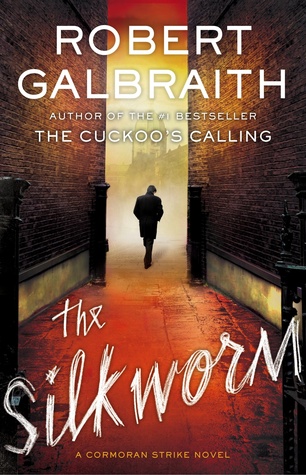 This was a great follow-up to Cuckoo's Calling that continued to flesh out the
main characters really well behind the scenes of a very interesting mystery.
This was a great follow-up to Cuckoo's Calling that continued to flesh out the
main characters really well behind the scenes of a very interesting mystery.
In this second book of the series, the stakes have risen somewhat, from an "accidental" crime of passion in the first book to a premeditated ritualistic murder complete with bizarre imagery and dozens of suspects in this one (perhaps too many suspects; it was just a tiny bit hard to keep track of who was who). I loved the way that secondary characters were brought in and interacted with Detective Strike, and his assistant / 'partner' Robin's increasing role in investigations. I loved that she brings different skills and benefits to the firm, and really compliments Strike's investigative style.
I love the (platonic - I hope that never changes)
relationship between Strike and Robin, though their lack of communication in this book did
annoy me, but in a very relatable way (I think we can all admit to not being as direct as we sometimes should).
#3: Career of Evil (2015)

This book was VERY tense all the way through in a way the previous two were not. Strike and Robin
(especially Robin) were placed in imminent danger right from the beginning, so the whole book was - I would go
so far as to say - stressful. I couldn't put it down because I just had
to know what happened next, especially with the threats hanging over the
character's heads.
Though the 'twist' at the end wasn't as surprising as in the first two books, there was still an element of unexpected revelation, which I appreciated. The story ended on a much more abrupt note than the previous books in the series - a real cliffhanger - so I really hope she writes at least one more book in the series, and soon!
Though the 'twist' at the end wasn't as surprising as in the first two books, there was still an element of unexpected revelation, which I appreciated. The story ended on a much more abrupt note than the previous books in the series - a real cliffhanger - so I really hope she writes at least one more book in the series, and soon!
Overall, I thought the entire Cormoran Strike series was really great. When the 4th one comes out (hopefully not too long from now!), I may go back and re-read 1-3. I like doing that with series anyway, but with these, I look forward to reading them knowing the endings, and looking out for the hints and clues that I didn't pick up on the first time I read them. Knowing Rowling's style, I'm sure there were many that I probably missed! This is especially true for Career of Evil, which I went through so fast just to see what happened that I really didn't experience the book as fully as I might have wanted.
Keep reading! Beth
Monday, October 26, 2015
Neil Gaiman, part 1: Short Stories
I've been a 'fan' of Neil Gaiman for a long time without really having read much of his work. This year, I've vowed to rectify that by delving into his many works, starting with some of his shorter items - a short novel and two illustrated short stories.
The Ocean at the End of the Lane (2013)
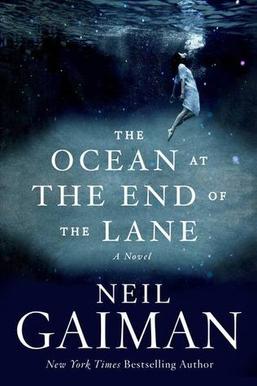 One of the things I think I like best about Neil Gaiman is that I never really know where his stories are going. He almost always incorporates at least a little bit of fantasy in his writings, and that of course opens up the possibilities of 'what could happen' to truly anything.
This was such a story, and I enjoyed just going along for the ride. I really liked the characters, and that there was quite a bit of ambiguity in who many of the characters were and what was going on. This style of writing (when not overused or abused) allows the reader to work their own imaginations a bit more, which I appreciate (up to a certain point at least). The only slight complaint was that the ending was a little unsatisfying, but overall a really fun little story about mistakes and manipulation.
The Truth is a Cave in the Black Mountains (2010)
 I actually listened to this first on audiobook, on the recommendation of a colleague. Read by Gaiman himself, it was a great way to be immersed in the feeling of the story. As it had originally been written with the intention of being read (or maybe even more accurately, performed) for an audience, I think it was an authentic experience.
This was what I would consider a modern fairy tale. I liked the way the story unfolded, and the twist at the end, however I do have one bone to pick with the ending. It's hard to explain in detail without giving a major spoiler, but suffice it to say that the backstory seems a little unrealistic to me and doesn't give the young woman in the story nearly enough credit. But, as with Ocean, I really enjoyed the ride.
The Sleeper and the Spindle (2014)

Another fairy tale, this time an update on both Snow White and Sleeping Beauty, and this one I loved, with no quibbles or complaints! I loved that Snow White was the protagonist and hero, and the twist at the end was great – much more interesting than the Disney version and quite a bit less violent than the Brothers Grimm original. In fact, I liked the story so much that I wish it had been longer. The illustrations by Chris Riddell were beautiful as well. Definitely a great, short read for adults and children alike.
Keep reading! Beth
The Ocean at the End of the Lane (2013)
One of the things I think I like best about Neil Gaiman is that I never really know where his stories are going. He almost always incorporates at least a little bit of fantasy in his writings, and that of course opens up the possibilities of 'what could happen' to truly anything.This was such a story, and I enjoyed just going along for the ride. I really liked the characters, and that there was quite a bit of ambiguity in who many of the characters were and what was going on. This style of writing (when not overused or abused) allows the reader to work their own imaginations a bit more, which I appreciate (up to a certain point at least). The only slight complaint was that the ending was a little unsatisfying, but overall a really fun little story about mistakes and manipulation.
The Truth is a Cave in the Black Mountains (2010)
 I actually listened to this first on audiobook, on the recommendation of a colleague. Read by Gaiman himself, it was a great way to be immersed in the feeling of the story. As it had originally been written with the intention of being read (or maybe even more accurately, performed) for an audience, I think it was an authentic experience.
 This was what I would consider a modern fairy tale. I liked the way the story unfolded, and the twist at the end, however I do have one bone to pick with the ending. It's hard to explain in detail without giving a major spoiler, but suffice it to say that the backstory seems a little unrealistic to me and doesn't give the young woman in the story nearly enough credit. But, as with Ocean, I really enjoyed the ride.
The Sleeper and the Spindle (2014)
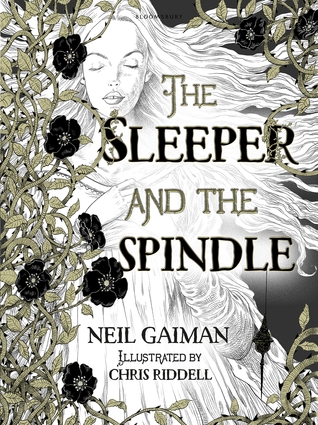
Another fairy tale, this time an update on both Snow White and Sleeping Beauty, and this one I loved, with no quibbles or complaints! I loved that Snow White was the protagonist and hero, and the twist at the end was great – much more interesting than the Disney version and quite a bit less violent than the Brothers Grimm original. In fact, I liked the story so much that I wish it had been longer. The illustrations by Chris Riddell were beautiful as well. Definitely a great, short read for adults and children alike.
Keep reading! Beth
Monday, September 28, 2015
Summer Reading Highlights, Part 5: Contemporary British - Mrs. Queen Takes the Train and The Book of Tomorrow
Mrs. Queen Takes the Train by William Kuhn
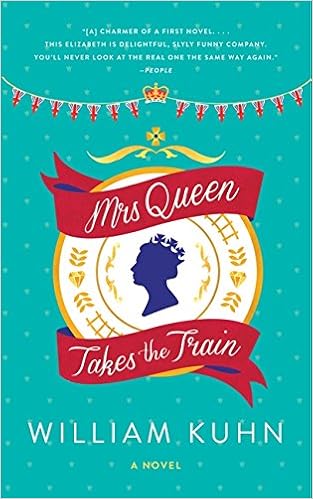
This was a very cute book about what Her Majesty the Queen of England might actually be like when the cameras are turned off and the crowds disperse. Having ruled the kingdom since her 20s, in this story the Queen is getting fairly tired and restless (I think justifiably!), and decides to act spontaneously in what can be assumed to be the first time in quite awhile.
I really liked the way that the story followed not only the Queen, but also the small handful of people affected by her impromptu jaunt, leading to a fairly well-balanced cast of characters (it's not all high tea and tiaras). However, having the story set from so many different perspectives, with flash-backs peppered throughout, did make for a somewhat confusing read. For such a light book, I really felt that I needed to pay attention!
But other than that minor quibble, this was a fun, easy read that I would highly recommend.
The Book of Tomorrow by Cecelia Ahern


This book started a little slow, and I wasn't sure how much I would like either the characters – especially the main character, who by her own admission was quite a brat – or the story line. Even when she found the mysterious book, I wasn't particularly taken. But then the mystery of the story and the supporting characters really picked up and I found myself not being able to put the book down.
I loved that the ultimate mystery solved by the end of the book hadn't even been something the main character (and therefore the reader) even knew was something to be solved! While she was busy worrying about one thing, suddenly another thing entirely came to light, and it made for a fairly suspenseful second half of the book. All in all, I think it's well worth wading through the set up in the beginning to get to the pay off at the end.
Keep reading! Beth
Monday, September 21, 2015
Summer Reading Highlights, Part 4: Mysteries – The Cuckoo’s Calling and The Crossing Places
The Cuckoo’s Calling by "Robert Galbraith" (aka J.K. Rowling)
 I was initially unsure if I would like this book or not, given how much I
disliked Rowling’s first adult book, The
Casual Vacancy. But where that book was filled with unlikeable people doing
terrible things, with a situation that simply kept going from bad to worse, Cuckoo’s Calling was filled with
interesting people in exciting situations. It was a curious contrast that Rowling’s
murder mystery was substantially less depressing with more sympathetic characters than the straight fiction, but that was indeed the case!
I was initially unsure if I would like this book or not, given how much I
disliked Rowling’s first adult book, The
Casual Vacancy. But where that book was filled with unlikeable people doing
terrible things, with a situation that simply kept going from bad to worse, Cuckoo’s Calling was filled with
interesting people in exciting situations. It was a curious contrast that Rowling’s
murder mystery was substantially less depressing with more sympathetic characters than the straight fiction, but that was indeed the case!
The story itself was suspenseful, but not scary, and had a great twist at
the end. Both the characters and the main and secondary stories were
compelling, and definitely made me excited to read the two sequels, The Silkworm and Career of Evil. After quite a bit of doubt from The Casual Vacancy, I think Cuckoo’s Calling shows that Rowling can
indeed write just as well for adults as she does for children.
Check out my review of the next 2 books in the series here.
Check out my review of the next 2 books in the series here.
The Crossing Places by Elly Griffiths

This was another mystery set in England (I’m sure you can start to see a
distinct trend in my reading choices), this time in the country as opposed to
London, where Cuckoo’s Calling was
set. Though at first glance the main characters of both mysteries share little in common -- Rowling's Cormoran Strike is a gruff, imposing ex-military type with a prosthetic leg, and Griffiths' Ruth Galloway is an anthropology professor with body image issues and a couple of cats. Both,
however, are emotionally vulnerable and lonely in their middle ages, which
makes them much more personable and relatable that they otherwise might have
been.
I loved that this modern mystery brought in some very interesting bits of history and lore, and I must say I was very proud of myself that my guesses were fairly close to the mark! Perhaps that means the story was a touch predictable; I still haven't decided if it's better or not if the reader is able to guess the correct suspect in a mystery. I was pretty close in this one and way off in Cuckoo's Calling, but I couldn't put either of them down, so if that's the real measure of a book's success, then both these mysteries came out winners.
Keep reading! Beth
I loved that this modern mystery brought in some very interesting bits of history and lore, and I must say I was very proud of myself that my guesses were fairly close to the mark! Perhaps that means the story was a touch predictable; I still haven't decided if it's better or not if the reader is able to guess the correct suspect in a mystery. I was pretty close in this one and way off in Cuckoo's Calling, but I couldn't put either of them down, so if that's the real measure of a book's success, then both these mysteries came out winners.
Keep reading! Beth
Monday, September 14, 2015
Summer Reading Highlights, Part 3: Jane Austen Spin-Offs – Longbourn and Death Comes to Pemberley
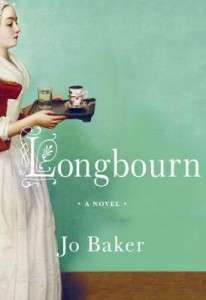 This book takes
place alongside the events of Pride and
Prejudice, this time from the perspective of the servants who tend to the Longbourn
estate and the Bennet family. In keeping with great TV shows such as Downton Abbey and Upstairs Downstairs, the stories of the ‘downstairs’ residents of
great English houses really completes the picture of what life really was like
in the 1800-1900s.
This book takes
place alongside the events of Pride and
Prejudice, this time from the perspective of the servants who tend to the Longbourn
estate and the Bennet family. In keeping with great TV shows such as Downton Abbey and Upstairs Downstairs, the stories of the ‘downstairs’ residents of
great English houses really completes the picture of what life really was like
in the 1800-1900s.
There were far
more Sarahs and Pollys than there were Elizabeth Bennets in the Georgian and
Regency eras, and their ways of life are often overlooked in favor of the
flashier upper class. Of course servants of grand houses were in much better
positions themselves than a great number of English citizens, as demonstrated
by the high desirability of such jobs. My favorite part of historical fiction
is developing a greater understanding of how people lived in different places
and times, and this story fits the bill nicely, while also fleshing out a
classic story!

This story is a
direct sequel to Austen’s classic, picking up the story of Elizabeth and Darcy
a few years after their wedding at the end of Pride and Prejudice, and adding in a juicy mystery to boot! I have
been a great fan of sequels and series since I was a child, always appreciating
the continuation of a story for characters I have grown to care about, and this
book doesn’t disappoint in that respect.
I loved reading
about (one possible version) of Elizabeth’s life at Pemberley as a wife and
mother, with almost all of the Bennets making an appearance. The framework of a
mystery was much more interesting to me than the simple romances that other
Austen sequels seem to feature (though this is the first I’ve read, so I
shouldn’t judge until I’ve tried the others out), though I might have
appreciated a story much more centered around Elizabeth and Darcy than Wickham
and Lydia. But that slight detail didn’t keep me from really enjoying this
book.
I wish James had
written more before she sadly passed away last year.
(Also, the BBC miniseries based on the book was great, and very close to the book!)
What are your favorite historical novels?
Keep reading! Beth
Tuesday, September 8, 2015
Summer Reading Highlights, Part 2: Historical Fiction – The Kitchen House and Remarkable Creatures
 This book
started off a little slow, but picked up really quickly until I found myself
not being able to put it down. Debut author Kathleen Grissom really knows how
to write characters that you care about, root for, and feel for. Taking place
at the height of the slave era in the south, the story was a unique window into
both sides of plantation life, with the main character Lavinia often times
uncomfortably straddling the inter-dependent worlds of landowners and slaves. Though the story was filled with lots of
heartbreak and tense situations, the heartwarming relationships, especially between Lavinia and Mama
Mae, were uplifting.
This book
started off a little slow, but picked up really quickly until I found myself
not being able to put it down. Debut author Kathleen Grissom really knows how
to write characters that you care about, root for, and feel for. Taking place
at the height of the slave era in the south, the story was a unique window into
both sides of plantation life, with the main character Lavinia often times
uncomfortably straddling the inter-dependent worlds of landowners and slaves. Though the story was filled with lots of
heartbreak and tense situations, the heartwarming relationships, especially between Lavinia and Mama
Mae, were uplifting.
The ending was a
satisfying conclusion to the story (I dislike endings that are too vague or open-ended),
while still leaving the possibility for much more story yet to come. I wish she
would write a sequel! But I’m trying to be respectful of the author and her
creative process as I anxiously await her second book (which of course may or may
not be a sequel), so many years after The Kitchen House was released.
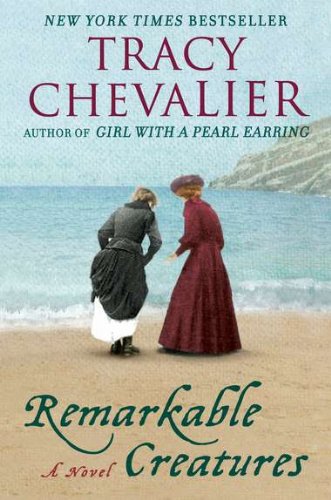
As a devoted
Anglophile, any story that takes place in England (or anywhere in the UK
really) is practically guaranteed to interest me. This one was of particular
interest because – as I discovered part-way through the book – the story is
based on real people.
The main
character, Mary Anning, was a poor girl from a working class family who lived during the Regency and Victorian Eras.
Decades before Charles Darwin made his discoveries on evolution, she became a
notable fossil hunter as she scoured the beaches of her hometown on the south coast of England. Despite not
knowing exactly what she was finding, she succeeded in (almost)
turning both the religious and scientific communities on their heads with her fossils of long-extinct creatures.
I love reading
about strong women who lead interesting lives, and this one certainly fit the
bill!
Keep reading! Beth
Keep reading! Beth
Subscribe to:
Posts (Atom)