Showing posts with label Death. Show all posts

Sunday, February 11, 2018

Above Us Only Sky by Michele Young-Stone


Above Us Only Sky (2015) by Michele Young-Stone was a beautiful, emotional book. I loved the relationship between the main character and her grandfather, and the way the story kept referring back to the experience of the grandfather and his family during violent, dangerous times of upheaval when he was a child. 

The conceit -- that the women of this family had a genetic 'gift' of being born with wings (a gift that is of course viewed with suspicion and medical alarm) -- was a lovely one that was woven well into the story without it being the main topic. This wasn't a fantasy book, but rather a fiction book about family and heritage with a fantasy twist (sometimes called magical realism).

I'm excited to read Young-Stone's new book, Lost in the Beehive, coming out this April, which looks like it will focus on friendship and mental health issues with just a twist of magical realism very similarly to Above Us Only Sky.

“I felt guilty because I was upset by the loss of one friend when the Old Man had lost nearly everyone he loved. Loss, I soon learned from him, is not measured in numbers. It's not comparative. It's in here. I'm touching my chest now.”
Keep reading! Beth


Wednesday, May 17, 2017

The Sisters Brothers by Patrick deWitt

Taking inspiration from the craze of the California Gold Rush and the madness it seemed to induce in the general populace and the individuals who participated, The Sisters Brothers (2011) by Patrick deWitt was a very good story from quite a different perspective than the books I typically read.

Wednesday, May 3, 2017

Dominion by C.J. Sansom

Dominion (2012) by C.J. Sansom offers an incredibly important view of World War II and what might have happened if the allies had tried appeasement and compromise instead of fighting back against Hitler. It really made me think a lot about war and what is truly worth fighting for; for every action, both fighting and not fighting, there are always consequences.

Wednesday, April 5, 2017

American Gods by Neil Gaiman

Just in time for the premier of the TV show later this month -- Neil Gaiman's book American Gods (2001) is a folk tale for the modern age with plenty of action and unexpected twists.

Wednesday, March 8, 2017

Dominion by C.J. Sansom

Dominion (2012) by C.J. Sansom was exciting, disturbing, interesting, and -- given current events -- pretty depressing. The story offered an incredibly important view of "what if" the allies had tried appeasement and compromise in relation to Hitler's reign. In not fighting back against the evil, the allies became the evil.

Wednesday, February 15, 2017

The Winter People by Jennifer McMahon

The Winter People (2014) by Jennifer McMahon is a wonderful book filled with excitement, mystery, troubling pasts, anticipation, and just enough of the supernatural (I won't say what kind -- that would give things away) to keep it interesting.

Flipping back and forth between the past and the present, I liked the connection that created, with the story weaving the two time periods together very effectively. The "New England" feel of both the setting and the story was very appealing and familiar to me as a life-long (and proud) New Englander myself.

Though the book has supernatural elements, the story was really more about loss and the relationships between mothers and daughters, both with good and especially with not-so-good associations, so don't let the idea of the supernatural turn you off if that's not normally your 'thing'. This is an excellent book to read in poor weather in a cozy chair with a hot drink. A perfect winter book (as the title implies)!

“I think people see what they want to see... But think about it: if you'd lost someone you love, wouldn't you give almost anything to have the chance to see them again?” 

Keep reading! Beth

Wednesday, August 31, 2016

Short "Ghost" Stories

The Grownup (2014) by Gillian Flynn

Very short story (originally written for a story collection) of suspense and twists, which leads you to question everything, and even keeps you guessing as to what genre the book fits into - horror? supernatural? mystery? suspense? All of the above? The ending is slightly unsatisfactory, but I found it more palatable in this short story format -- at least I only committed around an hour to reading it rather than a couple weeks, and the questionable nature of the ending was clearly the whole point of the story. Very clever, with some interesting characters.     


Springtime: A Ghost Story (2014) by Michelle de Kretser

Another short, somewhat confusing story. Unlike The Grownup, there was so little character development that even in the hour it took me to read, I still couldn't remember who some people were because they were presented in such a perfunctory and confusing way. Called itself a ghost story but had barely any ghost stuff in it, just a vague unease on the part of the main character that was not in any way translated to the reader. Reaction at the end: "huh?"

Overall, I think these were both interesting stories that made me think, and even though I didn't love either of them, the incredibly short reading time required by both stories I think made them worth it.

Keep reading! Beth


Monday, July 25, 2016

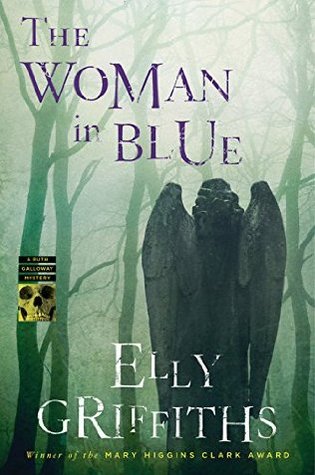
The Woman in Blue by Elly Griffiths

Finally catching up with Elly Griffiths' Ruth Galloway series with the latest entry, #8 - The Woman in Blue (2016).

Cathbad is back, and in top form! So good to see him back at the center of things relating to the mystery, though I'm somewhat disappointed that, while on maternity leave, Judy's character has been relegated to that of Cathbad's partner and mother of his new baby. Hopefully by the next book she'll be back on the force and see some real action.

The mystery itself was interesting; I like way Griffiths integrates different religious, pagan, and secular ways of thinking into many of her stories in a relatively equal way. I am inclined to believe that her personal beliefs run closest toward Ruth's own (as the main character), yet other characters (such as Cathbad and Father Hennessey) present a sympathetic view of other ways of thinking.

Overall, a nice continuation for a series that has really settled on a comfortable pattern, with the pros and cons that entails. I think you really know what you're getting with a Ruth Galloway mystery at this point, which is okay by me. Looking forward to the next one, which is expected sometime early 2017.

See my reviews of book 1, books 2-4, and books 5-7 posted earlier on this blog.

Keep reading! Beth


Wednesday, June 29, 2016

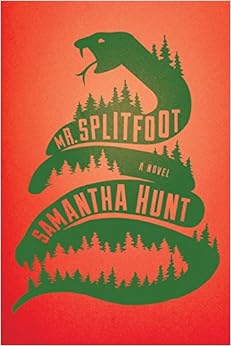
Mr. Splitfoot by Samantha Hunt

Here are the words that came to me as I read Mr. Splitfoot (2016) by Samantha Hunt:
dysfunction
chaos
suspense
sadness
fear
confusion 
A strange book, about which I was unsure for most of the time I was reading. Even more than half-way through, I was wondering why I was actually still reading it, especially as there was not nearly as much fantasy as the front flap description implied. But the story kept me going; I wasn't necessarily loving or even enjoying the book, but I really wanted to know what happened next.

Then twist ending made it worth it -- not only was it surprising, but it also resolved everything pretty neatly (which I always appreciate). A few things still left unsaid maybe, but anything not specifically explained was at least suggested -- good enough for me.

After I finished reading, this was one of those books that I had to just sit and think about for a few minutes, especially regarding people's general goodness (or lack thereof). The story really turned an unpleasant mirror on a sub-set of our culture most people try to ignore / forget about. Overall, this was a very interesting book that really made me think, and I was glad to have read it.
“Why do the living assume the dead know better than we do? Like they gained some knowledge by dying, but why wouldn't they just be the same confused people they were before they died?”

Keep reading! Beth


Tuesday, June 14, 2016

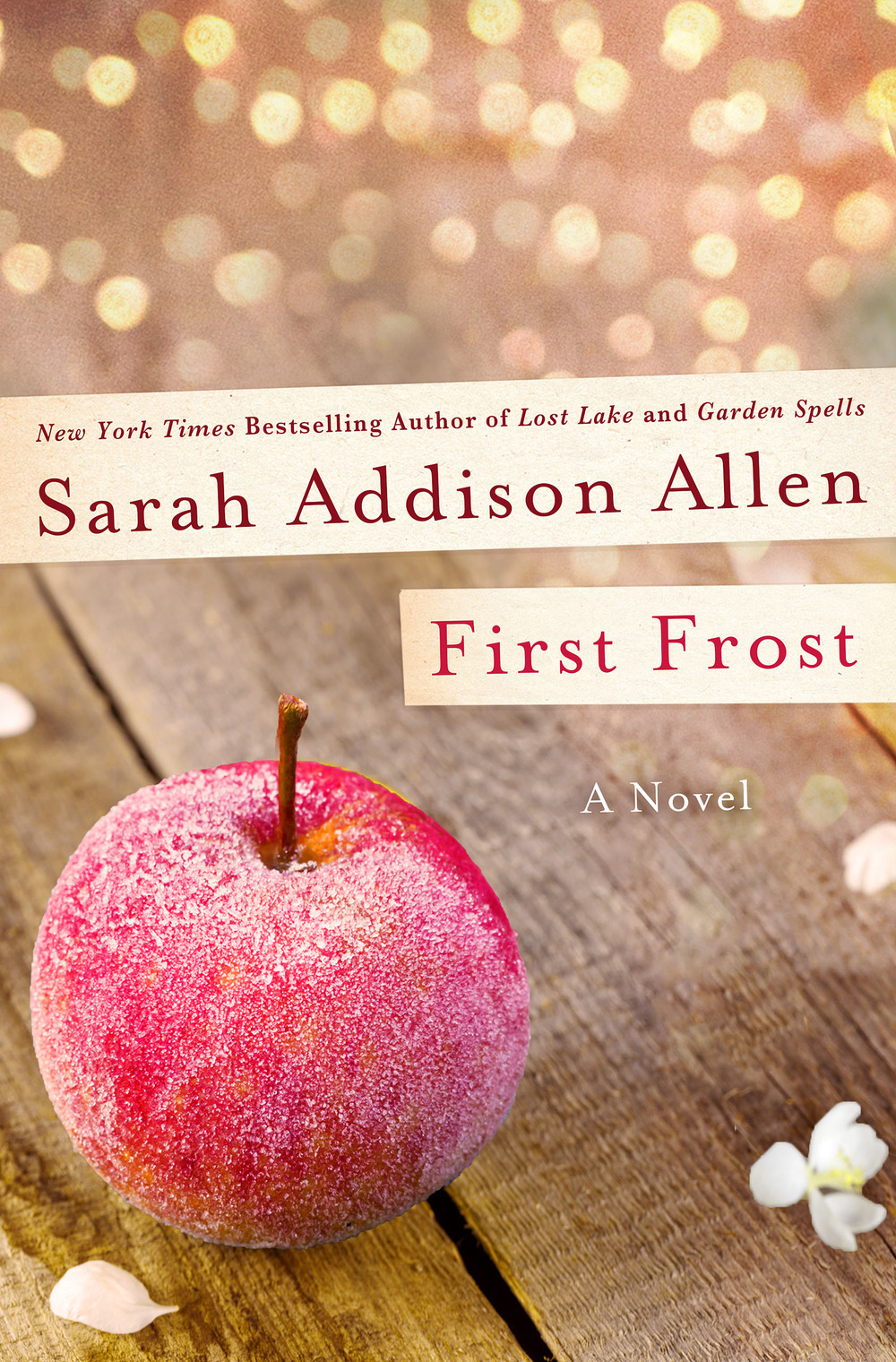
First Frost by Sarah Addison Allen

First Frost (2015) by Sarah Addison Allen was a lovely, uplifting sequel to Garden Spells (see my review of that book here). A heartwarming tale of belonging and families and relationships, knowing who you are and embracing that. Filled with very likable characters, who were flawed but (mostly) good, this book was an easy, comfortable read.

I really identified with Sydney's daughter Bay, now a high-school student set apart from her classmates by her different-ness. Though she is not shunned, she still feels 'other' and slightly isolated, knowing what she wants but not knowing how to get it -- while also dealing with the normal issues of growing up.

And even though I was frustrated by the way Sydney handled her receptionist Violet's issues, it was clear that Sydney knew it was frustrating for herself even, which made it much more understandable. (And, not to spoil anything, but I guess it worked out alright in the end...).

Overall, I would highly recommend both Garden Spells and First Frost when you want something that will captivate you without making you think too hard.
“It had taken her a long time to realize that a prison sometimes isn't a prison at all. Sometimes, it's simply a door you assume is locked because you've never tried to open it.” 

Keep reading! Beth

Tuesday, June 7, 2016

Ruth Galloway mystery series #5-7

Elly Griffiths continues her wonderful Ruth Galloway series in books 5-7, in which Ruth continues to solve crimes, inadvertently place herself in mortal danger, and struggle with her personal relationships in a rather endearing way. (See my review of book #1 of the series here, and books #2-4 here.)

#5: Dying Fall (2013) 

Yet another great entry in the series. I loved that Cathbad was a greater part of this story; we really got to know him better. And some additional insight into Nelson's character, being back in his hometown. Otherwise, it was a little silly that - having been in situations of mortal peril at least 3 times previously - Ruth still decides to go check out these bones with her daughter after getting threatening texts. Slightly unbelievable, but I guess it's good for the main character to have flaws and make bad decisions - it would be hard to really connect with her if she was perfect.
"'You need a break, a complete rest, recharge your batteries.' Recharge you batteries. What the hell does that mean? Nelson prides himself on not needing batteries. He's an old-fashioned, wind up model." (p. 21)

#6: The Outcast Dead (2014)  

The story in this one had a great sub-plot that really developed Judy's character especially. I'm very glad Tim has joined the team; I really like him. And so glad Cathbad has been given a reason and allowance to come back! Though I found his daughter, Maddie's, involvement in the case suspicious, it was nice to 'see' her again. And the way that the police case and the goings-on in Ruth's life intersected without Ruth officially working on the case was great and more realistic than Ruth officially consulting on every issue that comes to the police.


#7: The Ghost Fields (2015)  

It was -- interesting, I guess? -- that Nelson's wife Michelle got her own storyline in this book. I won't spoil too much by saying what this story was or my specific reaction to it, but regardless of what actually happened, I liked that she was given some additional character development outside of Nelson and Ruth. And I liked the way that Griffiths plays with suspicious of various characters, keeping you on your toes.

And that's me finally caught up on the Ruth Galloway series, just in time for the publication of book #8, The Woman in Blue, which came out May 3rd. Going to jump right into that one!

Keep reading! Beth

Friday, April 29, 2016

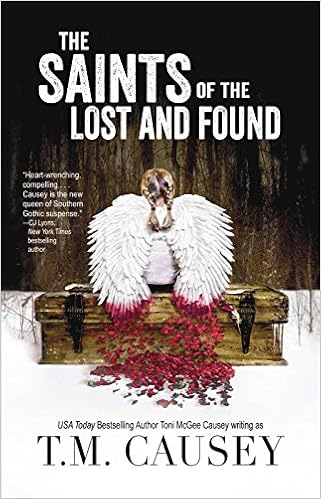
The Saints of the Lost and Found by T.M. Causey


Today, enjoy a guest post from staff member Lindsey! 

Avery Marie Broussard can see what other people have lost, from car keys to the greatest loss of their lives. Born to con artists, she is used by her parents to make millions over the course of her childhood. After a traumatic event, she finally escapes her hometown -- only to be lured back home by her family, where she is forced to confront the life and love she left so abruptly.

The Saints of the Lost and Found (2016) was utterly gripping. Causey did an amazing job delving into the psyche of someone who is constantly bombarded by the images and the pain of lost things. This is a story where someone’s superhuman abilities come at a heavy cost, and I came to greatly admire Avery’s drive to put herself in danger to help others. Over the course of the book, more and more of Avery’s past comes to light -- both to her and the reader -- making the climax tie in expertly with past and present.

I refuse to tell you any more about this book for fear of spoiling it for you but I will tell you this: I just finished the book and I am going read it again right now. I tore through it so fast the first time that I want to go back and really appreciate the story.

This is a quick read and well worth your time.

Keep reading! Lindsey

Monday, November 16, 2015

John Green, Pt. 1: The early works

In addition to Neil Gaiman, the other author of whom I have long been a fan without having read much (or any) of his books is John Green. I am a devoted fan of the many educational YouTube channels John and his brother Hank produce, including VlogBrothers, Crash Course, SciShow, and Mental Floss, and the podcast they do together, Dear Hank and John (all are wonderful and interesting). Both Green brothers are intelligent, funny, and kind, and I admire them both. About time, then, that I explored the many books that brought John Green to attention in the first place, starting with some of his earlier works.

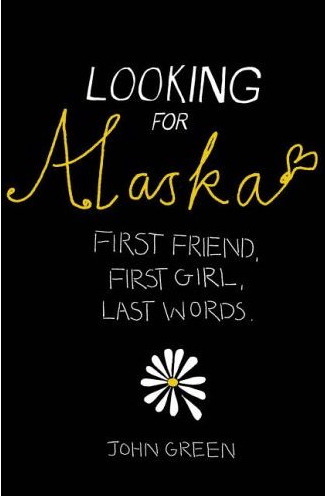
Looking for Alaska (2005)

Unfortunately I do have to start by saying that at first I was not especially taken with this book, filled as it was with either awkward, whiny teenagers or rebellious, irresponsible teenagers. I just didn’t connect with the characters at first, which I think is more of a function of the genre than the author. Contemporary Young Adult novels are not normally my genre of choice; what YA books I read are all fantasy-based. So I wonder how much of my initial reluctance was simply the lack of magic and mythology I'm used to in YA books.

Regardless, once I got to know the characters more, and especially their back stories, I liked them much more. The way the story dealt with death in the later part was very moving and – I think – pretty accurate. Of course everyone deals with death differently, so I’m not sure it would have been possible to have been inaccurate per se, but regardless it felt very real and personal to me and helped me connect with the way the characters were feeling. And there were some very nice life lessons in the end.
"We need never be hopeless, because we can never be irreparably broken... We cannot be born, and we cannot die. Like all energy, we can only change shapes and sizes and manifestations... [T]hat part of us greater than the sum of our parts cannot begin and cannot end, and so it cannot fail." (page 220-1)

An Abundance of Katherines (2006)

I did enjoy this book more than Alaska from the start. Though there was still a bit more teen angst than I’m accustomed to in the stories I choose to read, I liked all the main characters in this story much more quickly. Though I’m not sure what it says about my deeper foray into YA literature that maybe the character I liked the best was the adult (maybe that’s a sign that I’m getting to old to read YA – to which I say, no such thing! I still read children’s books too).

One major plot thread – taking down oral histories of members in a specific community – was something I found very intriguing, and I really appreciated that the characters were working toward something interesting and concrete. This connection with the community, especially with outsiders (as the two main characters were), I thought elevated the book beyond just 'YA' to a story that is relatable to all ages (though I don't really think most YA books should be read just by teenagers; I know many adults who read them).
"I don't think you can ever fill the empty space with the thing you lost... I don't think your missing pieces ever fit inside you again once they go missing." (page 201)

I like that John Green doesn’t speak down to his readers, that he assumes a certain amount of intelligence on our part (not an unreasonable amount; he is neither snobby nor preachy in his writing, which is also certainly appreciated). Overall, I'm glad I read both these books and look forward to reading some of his later works sometime soon.

Keep reading! Beth