
Showing posts with label Thriller. Show all posts
Showing posts with label Thriller. Show all posts
Wednesday, March 8, 2017
Dominion by C.J. Sansom
Dominion (2012) by C.J. Sansom was exciting, disturbing, interesting, and -- given current events -- pretty depressing. The story offered an incredibly important view of "what if" the allies had tried appeasement and compromise in relation to Hitler's reign. In not fighting back against the evil, the allies became the evil.

Friday, April 29, 2016
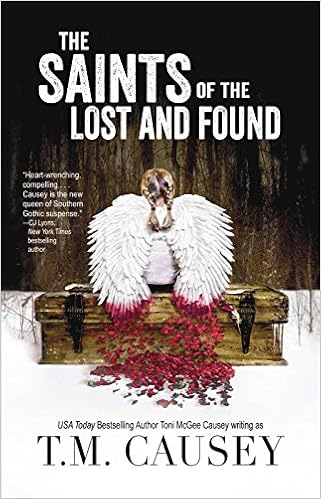
The Saints of the Lost and Found by T.M. Causey
Today, enjoy a guest post from staff member Lindsey!
Avery Marie Broussard can see what other people have lost, from car keys to the greatest loss of their lives. Born to con artists, she is used by her parents to make millions over the course of her childhood. After a traumatic event, she finally escapes her hometown -- only to be lured back home by her family, where she is forced to confront the life and love she left so abruptly.
The Saints of the Lost and Found (2016) was utterly gripping. Causey did an amazing job delving into the psyche of someone who is constantly bombarded by the images and the pain of lost things. This is a story where someone’s superhuman abilities come at a heavy cost, and I came to greatly admire Avery’s drive to put herself in danger to help others. Over the course of the book, more and more of Avery’s past comes to light -- both to her and the reader -- making the climax tie in expertly with past and present.
I refuse to tell you any more about this book for fear of spoiling it for you but I will tell you this: I just finished the book and I am going read it again right now. I tore through it so fast the first time that I want to go back and really appreciate the story.
This is a quick read and well worth your time.
Keep reading! Lindsey
Monday, February 1, 2016
Ruth Galloway Series #2-4 by Elly Griffiths
Ruth Galloway mysteries is a series of books written by Elly Griffiths, which center around the life of one (surprise, surprise) Ruth Galloway, a forensic archaeologist who teaches at a university in the Norfolk region of England and occasionally consults with the local police in cases involving unidentified bones. Ruth is a very likable, endearing character who -- despite being the 'heroine' of her own series -- is definitely human enough (and makes enough mistakes) to be truly relatable. I have greatly enjoyed the series so far, and look forward to reading the rest soon!
For my review of the first book in the series, see this post from this past summer.
#2: The Janus Stone (2010)
 I liked how realistic this story was, in the sense that lots of intelligent people contributed to solving the case, rather than one person displaying super-human skills of deduction. I also liked that at the end, though Ruth again was the one who ended up in danger, she saved herself just as much as (or more than) the men who rushed to her rescue.
#3: The House at Sea's End (2011)
One of the great things about this series is the secondary characters, and how they are developing as we get to know them better. Judy (the policewoman) is especially becoming an interesting character, unhappy as she already is in her new marriage. Of course Ruth ends up in mortal peril again in this book, but unlike the previous two books in the series, the ending was a total surprise; I had not guessed at all who the killer was and was totally fooled by all the twists in the story.
#4: A Room Full of Bones (2012)
Though in general, I'm not super thrilled by the whole affair story line developed early in the series, I do like the way Elly is handling the love triangle, and the continued development of the secondary characters. Cathbad especially is such an interesting character -- sometimes a bit too stereotypical, but always intriguing and very charming. I'm interested to see if he continues to be such a constant presence in the cases in future books. It's one of those instances where it feels like a bit of a stretch for him to be involved in every case (a bit along the lines of Ruth's involvement in the first place), but he's a such a great character I hope he sticks around.
The danger for a mystery series with a non-detective in the lead is that sometimes the ways to get the main character involved in each case gets more and more unrealistic. Ruth's involvement is addressed somewhat by her status as an official consultant, and of course there are plenty of local cases that are not mentioned that she has no hand in at all. Still, I hope that the core stories in each book continue to justify her central role in each investigation in a believable manner. Regardless, outside of the case details in each book (which are always interesting), it really is the characters that make these books worth reading.
Keep reading! Beth
For my review of the first book in the series, see this post from this past summer.
#2: The Janus Stone (2010)
 I liked how realistic this story was, in the sense that lots of intelligent people contributed to solving the case, rather than one person displaying super-human skills of deduction. I also liked that at the end, though Ruth again was the one who ended up in danger, she saved herself just as much as (or more than) the men who rushed to her rescue.
#3: The House at Sea's End (2011)
One of the great things about this series is the secondary characters, and how they are developing as we get to know them better. Judy (the policewoman) is especially becoming an interesting character, unhappy as she already is in her new marriage. Of course Ruth ends up in mortal peril again in this book, but unlike the previous two books in the series, the ending was a total surprise; I had not guessed at all who the killer was and was totally fooled by all the twists in the story.
#4: A Room Full of Bones (2012)
Though in general, I'm not super thrilled by the whole affair story line developed early in the series, I do like the way Elly is handling the love triangle, and the continued development of the secondary characters. Cathbad especially is such an interesting character -- sometimes a bit too stereotypical, but always intriguing and very charming. I'm interested to see if he continues to be such a constant presence in the cases in future books. It's one of those instances where it feels like a bit of a stretch for him to be involved in every case (a bit along the lines of Ruth's involvement in the first place), but he's a such a great character I hope he sticks around.
The danger for a mystery series with a non-detective in the lead is that sometimes the ways to get the main character involved in each case gets more and more unrealistic. Ruth's involvement is addressed somewhat by her status as an official consultant, and of course there are plenty of local cases that are not mentioned that she has no hand in at all. Still, I hope that the core stories in each book continue to justify her central role in each investigation in a believable manner. Regardless, outside of the case details in each book (which are always interesting), it really is the characters that make these books worth reading.
Keep reading! Beth
Friday, December 11, 2015
Roundtable Review: The Circle by Dave Eggers
In which several members of our staff who have all read the same book offer their differing thoughts and opinions. Today: a technological thriller and commentary on modern society by Dave Eggers, called The Circle (2013). Please note, there WILL be spoilers as we discuss all aspects of this book, including the ending!
For my original review of both this book and The Martian, check out this post of the blog.

CAROL J.: Creepy, authentic look at how capitalistic, technologically-driven corporations envision and expect the world to be. But can complete allegiance to one company, 24-7, and total worldwide data transparency be good for humanity?
ROSE: For me, The Circle by Dave Eggers follows in the footsteps of other dystopian novels like Huxley’s Brave New World, where different aspects of the present-day society are exaggerated and expanded into something disquieting. Mae Holland, a sweet young woman, is hired by a revered mega-Internet company, The Circle (which has some resemblances to Google, Facebook and Apple). Mae’s employers introduce her to the high expectations of The Circle: the 24/7 social interaction whirl of the employees, and the competitive video-game aspects of the work itself, which involves responding to customer emails rapidly and skillfully for hours, in order to amass a high rating.
The Circle is not great literature. The writing is on the level of a summer beach read: characters are not deep, and the story’s ending is rushed. But I would recommend it, since it held my interest, and the story moves along steadily. I cared about the main character, and was interested in her evolution. A number of the concepts (companies where employees can live 24/7, a constant barrage of social media, use of computers to measure work output) already exist at today’s corporations. We’re all aware of camera surveillance and drones; it’s a small step to imagining their presence everywhere.
But what I liked best about the story – and what stays with me – is the depiction of the relentless, privacy-smashing communal life that has an incredibly seductive pull: being part of the approving crowd, being watched over, protected and secure. I think The Circle would make a fine book for discussion, with concepts everyone in the 21st century can relate to.
ELLEN: In the spirit of 1984, The Jungle, and the latest craze for dystopian future novels, Dave Eggers has written a book that challenges the orthodoxy of increased public exposure of our personal lives on the Internet through gadgets and constant postings on bulletin boards and news feeds.
As a novel I found it a bit heavy-handed and I didn't find the central character, Mae Holland, all that believable, but I laughed mightily at the obvious representations of Facebook, Instagram, personal blogs, and YouTube. Companies like Google, whose products mesh so seamlessly into a web of interdependency, started out to claim the simplistic mantra, "Don't be evil" (their page outlining their philosophy).
At the same time, the digital storage of the world's data – including all literature, demographic information, and government documents – begs the question, "who controls the databank, who gets ready access, who controls speed of downloads, who holds the keys?" Something that starts out as a way for everyone to hold the power inevitably can morph into a power grab. Recent revelations on working conditions at Amazon, controversial as the sourcing is, raises the relevant question, "Can you succeed at a corporation and ever be offline and not at work?"
As the Young Adult Librarian, I love asking my teen group about privacy and the Internet. They have grown up with a digital presence in their lives. What is compelling is how much they find freedom and solace in what they see as the anonymity of creating an online identity. They find community and validation from others here and learn to create a voice in a group of fellow gamers, fan fiction writers, artists, and bloggers. They seem well aware of the pitfalls and know the safety issues but don't let that stop them from exploring and posting fearlessly.
 On a tangential note, David and I have talked about the need for a variety of digital curation web services similar to Maria Popova's Brain Pickings, and that libraries should consider this kind of extremely intense compilation work around issues and topics one of the new tasks for libraries to tackle. It will be the key, from my perspective, to maintaining a variety of hosts and voices.
Privacy is really a very modern value. In ancient times people lived in shoulder-to-shoulder contact with others for safety’s sake. How we balance our desire to live private lives against our natural compulsion for convenience and safety is a fascinating tension that Eggers' book broaches in an entertaining and ominous way.
JESS: When I read the synopsis of this book I thought to myself, "I'm never going to finish this. It doesn't sound suspenseful at all." The book is like a slow burn, it does take time to build but by then end I couldn't believe a book about a social media company had me on the edge of my seat.
This book made me feel uncomfortable and reflective, much like the scenes in Fahrenheit 451 when the main character's wife dives deeper and deeper into her hologram TV. It is a book that has stayed with me long after I finished. I didn't like the main character Mae and that's the whole point. There are two particular scenes that stand out in my head. One is a customer service job interaction between Mae and a businessman where the number of emails she gets asking her to rate his company and recommend his daughter for a job was excruciating painful. I was visibly stressed listening to this. Why does she put up with this? She has the power to make or break his business with a few sentences.
Another harrowing scene is when she is scolded by human resources for not "posting" about going kayaking – her one soulful, peaceful interaction with nature, ‘How could she not think to invite others who like to kayak?’ Even going so far as berating her for selfishly not videoing it for people who cannot kayak due to their own health issues. This company becomes more like a cult throughout the book but just when the reader starts to question it, something positive about the resource sharing happens, and it makes you rethink your feelings about the company.
The book's final climax ended abruptly but I think that's the point of the whole book. The loss of privacy in our era has left us highly informed but at what cost? How has it changed us as people? Are we stretched so thin that our human interactions are left on the surface? Food for thought the next time you think about posting on Facebook.
BETH: This book was great, but very disturbing. It almost felt like a prequel to any science fiction story – how we allow a slow spreading of technology into our lives until it eventually takes over completely. The scariest thing is that our present-day society, with everyone so deeply tied into and dependent on their phones, tablets, and computers is really not very far at all from the society in this book.
Though, as others have mentioned, the main character Mae was not entirely likeable, still you could see how she ended up getting in as deep as she did. Each step she took – every time she said yes to her supervisor’s requests – was understandable as an isolated incident. But for the reader, the book becomes more and more tense as you wonder where Mae's line will be; when she'll realize that broadcasting her entire life, with the only break being a minute of muted silence when she uses the restroom, is crazy.
When she persists even when she has to meet her best friend in the bathroom to have any semblance of private conversation, I was flabbergasted. When she literally drives someone to suicide and her parents underground and STILL continues to drink The Circle's Kool-Aid about wanting to be seen and known by everyone, and everyone having a right to see and know you, I was angry and frankly pretty sad. And when the book ended without any reasonable resolution, I really saw this as the beginning of the end of civilization in that society. And then I went outside.

Emma Watson and Tom Hanks are starring in the film adaptation of The Circle, which is currently set to come out sometime in 2016. It will be very interesting to see how they adapt the book to a movie, especially the later half of the story, which is told almost exclusively from a first-person perspective of Mae's camera.
Overall, I think all of us really enjoyed this book, though the feelings it elicited while reading were absolutely not always pleasant. It really made us all think and talk about the story and how it applies to our own lives, which after all is just about the best a book can do.
Keep reading! Beth
For my original review of both this book and The Martian, check out this post of the blog.

CAROL J.: Creepy, authentic look at how capitalistic, technologically-driven corporations envision and expect the world to be. But can complete allegiance to one company, 24-7, and total worldwide data transparency be good for humanity?
ROSE: For me, The Circle by Dave Eggers follows in the footsteps of other dystopian novels like Huxley’s Brave New World, where different aspects of the present-day society are exaggerated and expanded into something disquieting. Mae Holland, a sweet young woman, is hired by a revered mega-Internet company, The Circle (which has some resemblances to Google, Facebook and Apple). Mae’s employers introduce her to the high expectations of The Circle: the 24/7 social interaction whirl of the employees, and the competitive video-game aspects of the work itself, which involves responding to customer emails rapidly and skillfully for hours, in order to amass a high rating.
The Circle is not great literature. The writing is on the level of a summer beach read: characters are not deep, and the story’s ending is rushed. But I would recommend it, since it held my interest, and the story moves along steadily. I cared about the main character, and was interested in her evolution. A number of the concepts (companies where employees can live 24/7, a constant barrage of social media, use of computers to measure work output) already exist at today’s corporations. We’re all aware of camera surveillance and drones; it’s a small step to imagining their presence everywhere.
But what I liked best about the story – and what stays with me – is the depiction of the relentless, privacy-smashing communal life that has an incredibly seductive pull: being part of the approving crowd, being watched over, protected and secure. I think The Circle would make a fine book for discussion, with concepts everyone in the 21st century can relate to.
ELLEN: In the spirit of 1984, The Jungle, and the latest craze for dystopian future novels, Dave Eggers has written a book that challenges the orthodoxy of increased public exposure of our personal lives on the Internet through gadgets and constant postings on bulletin boards and news feeds.
As a novel I found it a bit heavy-handed and I didn't find the central character, Mae Holland, all that believable, but I laughed mightily at the obvious representations of Facebook, Instagram, personal blogs, and YouTube. Companies like Google, whose products mesh so seamlessly into a web of interdependency, started out to claim the simplistic mantra, "Don't be evil" (their page outlining their philosophy).
At the same time, the digital storage of the world's data – including all literature, demographic information, and government documents – begs the question, "who controls the databank, who gets ready access, who controls speed of downloads, who holds the keys?" Something that starts out as a way for everyone to hold the power inevitably can morph into a power grab. Recent revelations on working conditions at Amazon, controversial as the sourcing is, raises the relevant question, "Can you succeed at a corporation and ever be offline and not at work?"
As the Young Adult Librarian, I love asking my teen group about privacy and the Internet. They have grown up with a digital presence in their lives. What is compelling is how much they find freedom and solace in what they see as the anonymity of creating an online identity. They find community and validation from others here and learn to create a voice in a group of fellow gamers, fan fiction writers, artists, and bloggers. They seem well aware of the pitfalls and know the safety issues but don't let that stop them from exploring and posting fearlessly.
 On a tangential note, David and I have talked about the need for a variety of digital curation web services similar to Maria Popova's Brain Pickings, and that libraries should consider this kind of extremely intense compilation work around issues and topics one of the new tasks for libraries to tackle. It will be the key, from my perspective, to maintaining a variety of hosts and voices.
Privacy is really a very modern value. In ancient times people lived in shoulder-to-shoulder contact with others for safety’s sake. How we balance our desire to live private lives against our natural compulsion for convenience and safety is a fascinating tension that Eggers' book broaches in an entertaining and ominous way.
JESS: When I read the synopsis of this book I thought to myself, "I'm never going to finish this. It doesn't sound suspenseful at all." The book is like a slow burn, it does take time to build but by then end I couldn't believe a book about a social media company had me on the edge of my seat.
This book made me feel uncomfortable and reflective, much like the scenes in Fahrenheit 451 when the main character's wife dives deeper and deeper into her hologram TV. It is a book that has stayed with me long after I finished. I didn't like the main character Mae and that's the whole point. There are two particular scenes that stand out in my head. One is a customer service job interaction between Mae and a businessman where the number of emails she gets asking her to rate his company and recommend his daughter for a job was excruciating painful. I was visibly stressed listening to this. Why does she put up with this? She has the power to make or break his business with a few sentences.
Another harrowing scene is when she is scolded by human resources for not "posting" about going kayaking – her one soulful, peaceful interaction with nature, ‘How could she not think to invite others who like to kayak?’ Even going so far as berating her for selfishly not videoing it for people who cannot kayak due to their own health issues. This company becomes more like a cult throughout the book but just when the reader starts to question it, something positive about the resource sharing happens, and it makes you rethink your feelings about the company.
The book's final climax ended abruptly but I think that's the point of the whole book. The loss of privacy in our era has left us highly informed but at what cost? How has it changed us as people? Are we stretched so thin that our human interactions are left on the surface? Food for thought the next time you think about posting on Facebook.
BETH: This book was great, but very disturbing. It almost felt like a prequel to any science fiction story – how we allow a slow spreading of technology into our lives until it eventually takes over completely. The scariest thing is that our present-day society, with everyone so deeply tied into and dependent on their phones, tablets, and computers is really not very far at all from the society in this book.
Though, as others have mentioned, the main character Mae was not entirely likeable, still you could see how she ended up getting in as deep as she did. Each step she took – every time she said yes to her supervisor’s requests – was understandable as an isolated incident. But for the reader, the book becomes more and more tense as you wonder where Mae's line will be; when she'll realize that broadcasting her entire life, with the only break being a minute of muted silence when she uses the restroom, is crazy.
When she persists even when she has to meet her best friend in the bathroom to have any semblance of private conversation, I was flabbergasted. When she literally drives someone to suicide and her parents underground and STILL continues to drink The Circle's Kool-Aid about wanting to be seen and known by everyone, and everyone having a right to see and know you, I was angry and frankly pretty sad. And when the book ended without any reasonable resolution, I really saw this as the beginning of the end of civilization in that society. And then I went outside.

Emma Watson and Tom Hanks are starring in the film adaptation of The Circle, which is currently set to come out sometime in 2016. It will be very interesting to see how they adapt the book to a movie, especially the later half of the story, which is told almost exclusively from a first-person perspective of Mae's camera.
Overall, I think all of us really enjoyed this book, though the feelings it elicited while reading were absolutely not always pleasant. It really made us all think and talk about the story and how it applies to our own lives, which after all is just about the best a book can do.
Keep reading! Beth
Subscribe to:
Posts (Atom)