Wednesday, September 28, 2016

The Last Bookaneer by Matthew Pearl

The Last Bookaneer (2015) by Matthew Pearl is a very interesting book with a great concept that didn't quite live up to the thrilling precedent set by Pearl's previous books I've read -- but was an enjoyable read just the same.

I like books and pirates are pretty cool, so the idea of book pirates has a lot going for it, which is why I originally picked up this book (that, and I really loved The Technologists and The Dante Club). While there was certainly plenty of action in this book, I think it wasn't quite at the level of his previous books mostly because of the narrative structure -- as most of the story is told via a character reminiscing, there is less at stake. You of course know right away that the narrator lives through the story since he is telling it! And there was a little bit less overall character development than I would have liked.

But the setting was lovely (I liked the contrast between Europe and the tropics) and the combination of books, legal quagmires, adventure, sea travel, and famous authors made it a fun read. And I certainly appreciated the extent to which books themselves were honored by many of the characters in the story.

At the end, I was glad to have read the book -- it was a good story, it just maybe wasn't what I was expecting based on his other books. This was much more in the category of adventure fiction, rather than literary thriller. Overall, pretty good.

“Strangers talking over piles of books do not remain strangers for long.” (p. 22) 
“Authors do not create literature; they are consumed by it. As a bookseller, I am often asked if I didn’t dream of being an author, but I should rather think it is the author who learns to dream of becoming a bookseller. I do not seek the mantle of genius. I am an appreciator, an observer, a preposition, and content in that, and that is me in a nutshell.” (p. 90)

Keep reading! Beth

Wednesday, September 21, 2016

Dad is Fat by Jim Gaffigan

Dad is Fat (2013) by Jim Gaffigan (of the Hot Pockets joke fame) is absolutely hilarious, as expected! Even for someone without kids, many of his observations still resonated with me and made me laugh out loud - a lot!

He writes in a very tongue-in-cheek manner, often directly addressing the reader, always in a very funny way. I loved this style, which really made reading the book feel very intimate, like I was having a conversation rather than passively reading (which was of course what I was actually doing, but still...). He really made me feel 'in' on his jokes, and I loved it.

I don't want to spoil too many of the punch lines, but here were two of my favorite jokes from the book:
“Every morning after I get up, I always gaze longingly at my bed and lament, ‘You were wonderful last night. I didn’t want it to end. I can’t wait to see you again…’” (192) 
“I guess you could say I’m allergic to camping. Jeannie loves camping because she says camping was a tradition in her family. I always point out that prior to the invention of the house, camping was a tradition in everyone’s family. I don’t get camping. ‘Hey, want to burn a couple of vacation days sleeping on the ground outside? Chances are you’ll wake up freezing and covered in a rash?” No, thanks. If camping was so great, why are the bugs always trying to get in your house?” (258-9)
I completely agree Jim!

Keep reading! Beth

Wednesday, September 14, 2016

Paper Towns by John Green

Paper Towns (2008) is John Green's third solo book, and I think his best of the ones I've read so far. It was sweet, funny, exciting, compelling, interesting... it had it all. Mystery, 'romance,' suspense, fear, longing, heartache and heartbreak, dead bodies, final exams, and a road trip. What more could you want?

I really, really loved all these characters -- they were fun, funny, well-rounded, complete characters. It was a pleasure to live in their world for a little while. The road trip part was the best -- I was crying laughing at one point, and I really wished it had lasted longer.

The thing I loved the most about this book was that it was about a boy and a girl, and love, relationships, etc. but it wasn't REALLY about that -- it was about growing up and figuring out who you are and what you want, and accepting other people for who they truly are, and just figuring out people. So lovely!

The movie version was a pretty good adaptation -- of course not as complex and well-rounded as the book, and they left out some of my favorite parts of the book, but a nice movie in its own right. Good movie, great book!

"[E]ach of us starts out as a watertight vessel. And these things happen -- these people leave us, or don't love us, or don't get us, or we don't get them, and we lose and fail and hurt one another. And the vessel starts to crack open in places. And I mean, yeah, once the vessel starts to crack open, the end becomes inevitable... But there is all this time between when the cracks start to open up and when we finally fall apart. And it's only in that time that we can see one another, because we see out of ourselves through the cracks and into others through theirs... [O]nce the vessel cracks, the light can get in. The light can get out."--Quentin (p.302)

See my review of John Green's first two books here.

Keep reading! Beth

Wednesday, September 7, 2016

Amazing Fantastic Incredible: A Marvelous Memoir by Stan Lee

Amazing Fantastic Incredible: A Marvelous Memoir (2015) by Stan Lee is hilarious, adorable, and illuminating -- a must-read for anyone into comics and/or super-heroes. Set in the form of a graphic novel, this memoir spans Lee's entire life, and therefore most of the 'life' of Marvel comics, from way before they were called Marvel comics.  

I thought it was interesting how he referred to people who ended up leaving the 'fold' as it were after being a big part of the comics productions. I liked that Lee acknowledged that some issues might have been his fault -- without really making himself look bad. A very tough balance! And he brought up some painful memories he didn't necessarily have to (like his wife's inability to have more children) in such an open and honest way that I was really impressed.

Overall, Stan Lee was humorously self-deprecating, clearly loves his wife and his work, and just seems like a wonderful person to be around. I hope he stays around for a good long time yet!

“Oh! Here’s one example of how we tried to have things at least vaguely grounded in science in the Marvel Universe. I wanted Thor to be able to fly. But I hated the idea of him just hurling through the air with no support. I figured, hey, he has a war hammer called Mjolnir, so how about he will have that hammer with him. And when he wants to fly he’ll whirl it around his head really fast, and then he’ll throw it, and since he’s attached to it by the thong around his wrist – when the hammer goes flying, it’ll take him with it! To this day I don’t know why NASA hasn’t invited me to join their science team.”

Keep reading! Beth

Wednesday, August 31, 2016

Short "Ghost" Stories

The Grownup (2014) by Gillian Flynn

Very short story (originally written for a story collection) of suspense and twists, which leads you to question everything, and even keeps you guessing as to what genre the book fits into - horror? supernatural? mystery? suspense? All of the above? The ending is slightly unsatisfactory, but I found it more palatable in this short story format -- at least I only committed around an hour to reading it rather than a couple weeks, and the questionable nature of the ending was clearly the whole point of the story. Very clever, with some interesting characters.     


Springtime: A Ghost Story (2014) by Michelle de Kretser

Another short, somewhat confusing story. Unlike The Grownup, there was so little character development that even in the hour it took me to read, I still couldn't remember who some people were because they were presented in such a perfunctory and confusing way. Called itself a ghost story but had barely any ghost stuff in it, just a vague unease on the part of the main character that was not in any way translated to the reader. Reaction at the end: "huh?"

Overall, I think these were both interesting stories that made me think, and even though I didn't love either of them, the incredibly short reading time required by both stories I think made them worth it.

Keep reading! Beth


Monday, August 22, 2016

The Drums of Autumn (Outlander series #4)

The Drums of Autumn (1996) by Diana Gabaldon is yet another wonderful addition to this gripping series of time travel, romance, and family - and some violence and revenge.

After the wonderful "Pirates of the Caribbean" plot that encompassed book #3 (see my review of that book here, and a staff roundtable review of books #1-2 here), Jaime and Claire are firmly settled in the New World, and so this book was filled with exciting stories of colonizing the American South in the mid-1700s.

I absolutely loved the framework of exploring and pioneering, especially setting up a homestead from scratch with almost nothing but bare hands and force of will. I really loved the slow, day-to-day scenes in the book, the small bits about putting up food and building structures. This is a period of time that has always fascinated me since my childhood obsession with the Little House books, and I was glad to have reminders of that in this (much more adult) series. One of the things I like best about historical fiction is the insight it gives readers into how people lived in a particular place and time, not just the big events that everyone learns about in school.

And, without giving too much away, there was quite a lot that happened in the book that surprised me, especially the storyline with Bree and Roger, and the plot with Ian. His story especially was part of the reason I could not put the book down in the second half - I just had to know what was going to happen with him!

One of my only complaints is how much Fergus has been pushed to the sidelines now that he's set up with his own family. I really like him -- indeed, he was perhaps my favorite character in books #2-3 -- and hope he becomes a more central character in the future (though not, I suppose, if that must come at the expense of his family!)
“Forgiveness is not a single act, but a matter of constant practice”
Keep reading! Beth

Wednesday, August 3, 2016

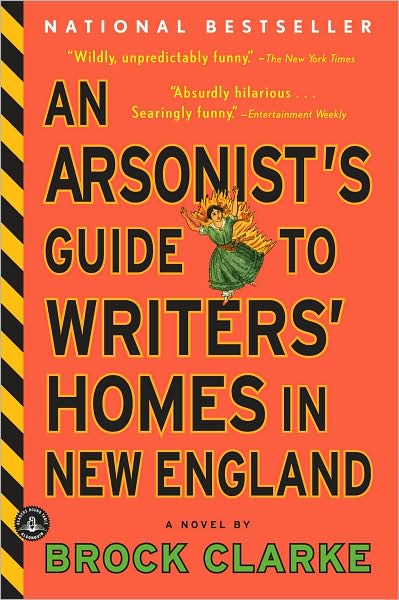
An Arsonist's Guide to Writer's Homes in New England by Brock Clarke

An Arsonist's Guide to Writer's Homes in New England (2007) by Brock Clarke is an interesting book, one I was a little conflicted about for most of the time I was reading.

Following a completely avoidable accident that landed him in jail as a teenager, Sam Pulsifer's short break of normalcy following being released from prison as an adult is disrupted when his past comes back to haunt him (somewhat literally). Surrounded by other people also making poor decisions, this story was somewhat frustrating but also endearing at the same time; even though it was painful to read as Sam makes mistake after mistake, you can't help but feel for the guy.

At the end, I was mostly glad to have read the book. But one note of caution: do not bother to read this at all if you have a particular problem with main narrators who are (self-professed) bumbling idiots who make nothing but the obviously wrong decisions in every situation. There's a lot of that. But there is also decent character development, an interesting literary connection, and somewhat amusingly dysfunctional family relationships.
“If only my mother had a book to hold, she wouldn't have looked so lonely. And maybe this was another reason why people read: not so they would feel less lonely, but so that other people would think they looked less lonely with a book in their hands and therefore not pity them and leave them alone.”
Keep reading! Beth