The 5th book in Diana Gabaldon's Outlander series, The Fiery Cross (2001) follows immediately after the events of book 4, and therefore maintains both the wonderful writing and interesting characters and settings we've become used to.
Showing posts with label American south. Show all posts
Showing posts with label American south. Show all posts
Wednesday, April 19, 2017

Monday, August 22, 2016
The Drums of Autumn (Outlander series #4)
The Drums of Autumn (1996) by Diana Gabaldon is yet another wonderful addition to this gripping series of time travel, romance, and family - and some violence and revenge.
 After the wonderful "Pirates of the Caribbean" plot that encompassed book #3 (see my review of that book here, and a staff roundtable review of books #1-2 here), Jaime and Claire are firmly settled in the New World, and so this book was filled with exciting stories of colonizing the American South in the mid-1700s.
I absolutely loved the framework of exploring and pioneering, especially setting up a homestead from scratch with almost nothing but bare hands and force of will. I really loved the slow, day-to-day scenes in the book, the small bits about putting up food and building structures. This is a period of time that has always fascinated me since my childhood obsession with the Little House books, and I was glad to have reminders of that in this (much more adult) series. One of the things I like best about historical fiction is the insight it gives readers into how people lived in a particular place and time, not just the big events that everyone learns about in school.
And, without giving too much away, there was quite a lot that happened in the book that surprised me, especially the storyline with Bree and Roger, and the plot with Ian. His story especially was part of the reason I could not put the book down in the second half - I just had to know what was going to happen with him!
One of my only complaints is how much Fergus has been pushed to the sidelines now that he's set up with his own family. I really like him -- indeed, he was perhaps my favorite character in books #2-3 -- and hope he becomes a more central character in the future (though not, I suppose, if that must come at the expense of his family!)
 After the wonderful "Pirates of the Caribbean" plot that encompassed book #3 (see my review of that book here, and a staff roundtable review of books #1-2 here), Jaime and Claire are firmly settled in the New World, and so this book was filled with exciting stories of colonizing the American South in the mid-1700s.
I absolutely loved the framework of exploring and pioneering, especially setting up a homestead from scratch with almost nothing but bare hands and force of will. I really loved the slow, day-to-day scenes in the book, the small bits about putting up food and building structures. This is a period of time that has always fascinated me since my childhood obsession with the Little House books, and I was glad to have reminders of that in this (much more adult) series. One of the things I like best about historical fiction is the insight it gives readers into how people lived in a particular place and time, not just the big events that everyone learns about in school.
And, without giving too much away, there was quite a lot that happened in the book that surprised me, especially the storyline with Bree and Roger, and the plot with Ian. His story especially was part of the reason I could not put the book down in the second half - I just had to know what was going to happen with him!
One of my only complaints is how much Fergus has been pushed to the sidelines now that he's set up with his own family. I really like him -- indeed, he was perhaps my favorite character in books #2-3 -- and hope he becomes a more central character in the future (though not, I suppose, if that must come at the expense of his family!)
“Forgiveness is not a single act, but a matter of constant practice”Keep reading! Beth
Tuesday, June 14, 2016
First Frost by Sarah Addison Allen
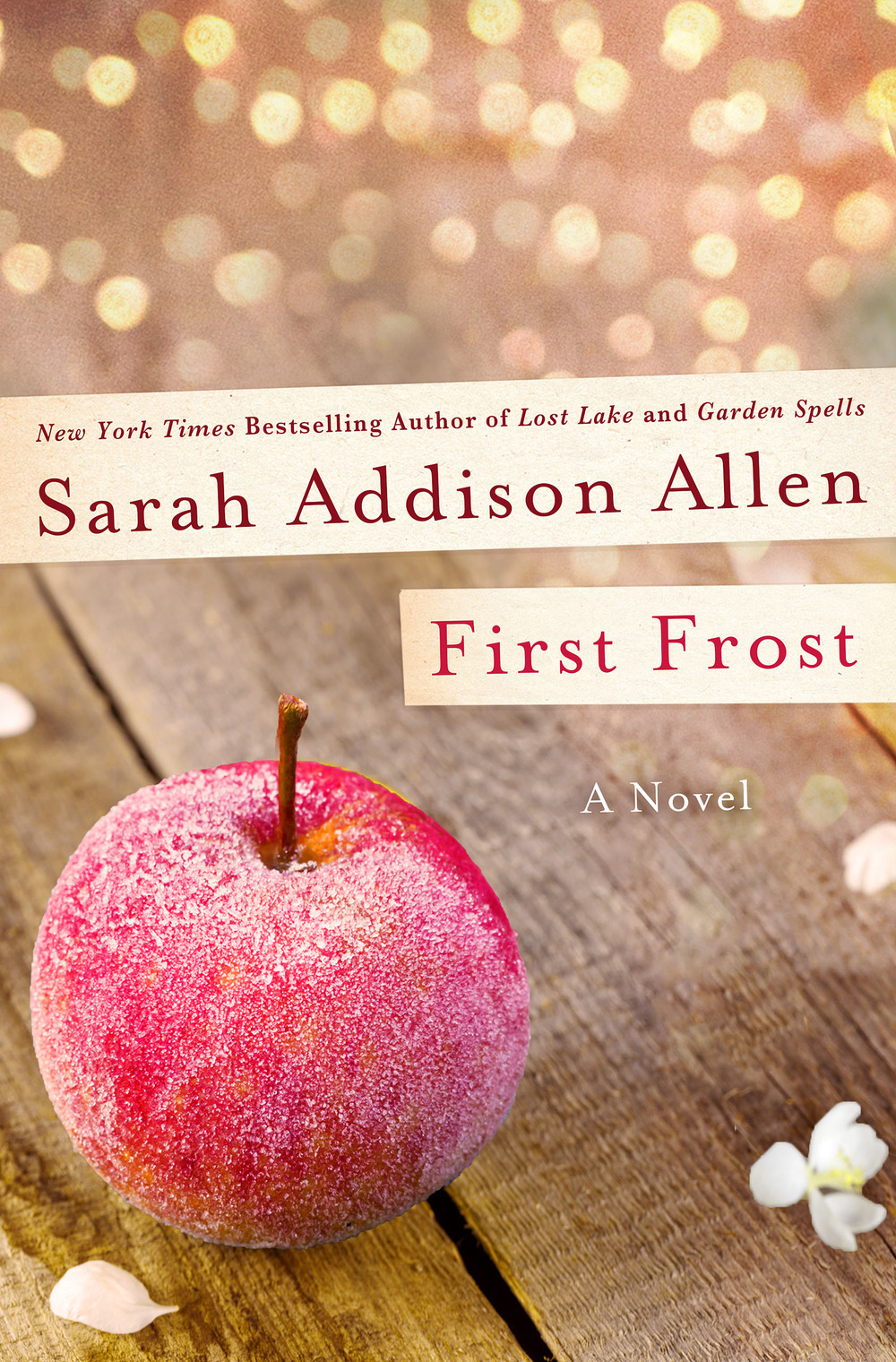 First Frost (2015) by Sarah Addison Allen was a lovely, uplifting sequel to Garden Spells (see my review of that book here). A heartwarming tale of belonging and families and relationships, knowing who you are and embracing that. Filled with very likable characters, who were flawed but (mostly) good, this book was an easy, comfortable read.
 I really identified with Sydney's daughter Bay, now a high-school student set apart from her classmates by her different-ness. Though she is not shunned, she still feels 'other' and slightly isolated, knowing what she wants but not knowing how to get it -- while also dealing with the normal issues of growing up.
And even though I was frustrated by the way Sydney handled her receptionist Violet's issues, it was clear that Sydney knew it was frustrating for herself even, which made it much more understandable. (And, not to spoil anything, but I guess it worked out alright in the end...).
Overall, I would highly recommend both Garden Spells and First Frost when you want something that will captivate you without making you think too hard.
“It had taken her a long time to realize that a prison sometimes isn't a prison at all. Sometimes, it's simply a door you assume is locked because you've never tried to open it.”
Keep reading! Beth
Friday, April 29, 2016
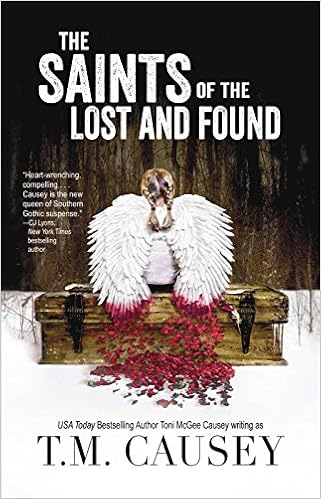
The Saints of the Lost and Found by T.M. Causey
Today, enjoy a guest post from staff member Lindsey!
Avery Marie Broussard can see what other people have lost, from car keys to the greatest loss of their lives. Born to con artists, she is used by her parents to make millions over the course of her childhood. After a traumatic event, she finally escapes her hometown -- only to be lured back home by her family, where she is forced to confront the life and love she left so abruptly.
The Saints of the Lost and Found (2016) was utterly gripping. Causey did an amazing job delving into the psyche of someone who is constantly bombarded by the images and the pain of lost things. This is a story where someone’s superhuman abilities come at a heavy cost, and I came to greatly admire Avery’s drive to put herself in danger to help others. Over the course of the book, more and more of Avery’s past comes to light -- both to her and the reader -- making the climax tie in expertly with past and present.
I refuse to tell you any more about this book for fear of spoiling it for you but I will tell you this: I just finished the book and I am going read it again right now. I tore through it so fast the first time that I want to go back and really appreciate the story.
This is a quick read and well worth your time.
Keep reading! Lindsey
Friday, April 22, 2016
Glory Over Everything by Kathleen Grissom
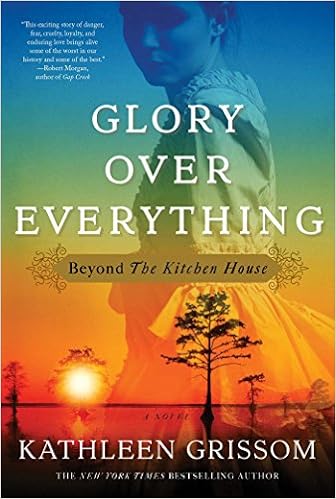 Glory Over Everything: Beyond the Kitchen House (2016) by Kathleen Grissom is the long-awaited sequel to her 2010 debut, The Kitchen House. I loved the original (read my review here), and am so happy that she continued the story!
Grissom continues to demonstrate a fantastic ability to write characters that you connect with immediately, which was one of the things I was so impressed by in her first book. And in this case specifically, she took a character (James) who was not particularly likeable in The Kitchen House as a child, and gave him such depth that you couldn't help but feel for him in this book. Even though he was anything but perfect, his actions were so understandable and... human... that even if you saw the mistake and its inevitable consequences coming, you get why he did what he did.
Some of the other characters were slightly less understandable -- namely Pan, who made such a wilful, obvious mistake that it was hard to do anything but shake your head at him. But still, he was such an endearing, sincere kid that you felt for him and desperately wanted him to be safe.
And Robert, James's resourceful and unflaggingly loyal butler, was the true hero of the story, swooping in and out with just the right word and idea at key points. I loved his composure and grace, though I liked to imagine that there was a good bit of snark behind that stoic exterior.
This was such a wonderful story, I'm sure this review won't do it justice. Though it started off in a little bit of a disjointed manner, the flashbacks come fairly early on in the book and really provide a complete picture. It was a thrilling page-turner, a heart-pounding look into the Underground Railroad, filled with characters I was truly invested in. You could certainly read it as a stand-alone without much confusion, but I would urge you to read both together -- they are truly worth it! Hopefully the story will continue within the next six years (hint, hint Kathleen...).
Keep reading! Beth
Monday, March 14, 2016
Bats of the Republic by Zachary Thomas Dodson
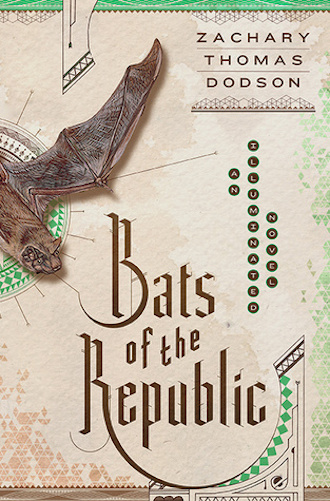 Bats of the Republic: an Illuminated Novel (2015) by Zachary Thomas Dodson was a very interesting book. I loved the unusual format, with the story told in several formats from several points of view, and all the ephemera throughout (maps, drawings, notes, etc.). The nature drawings and observations of the wildlife in the frontier were especially great, and I really do like when the idea of a "book within a book" is used well.
The story built up quite quickly to a point where I really just had to know what was going to happen, especially with the famous letter that was the center of most of the main characters' stories, with the 'past' storyline about delivering the letter and the 'future' storyline about finding it. I also really liked the setting of both the parts of the book in the 'frontier' era of a slightly different past than in our own universe and the post-apocalyptic future, with Big Brother-like ruling class.
The build-up of the story was very tense and really made you feel the stress the characters were going through. Unfortunately the ending had very little pay-off for all this build up. It resolved almost no part of the story, and never actually clarified this mysterious letter that was such a big part of the story. I was glad to have read it, but the ending really disappointed me. However, if you're not a person who prefers (needs) a very concrete, conclusive ending to your stories, then I think this wouldn't be as big of a problem. Overall, I do think this is a book worth reading as the story and format are so unusual and interesting.

Keep reading! Beth
Tuesday, January 26, 2016
Garden Spells by Sarah Addison Allen
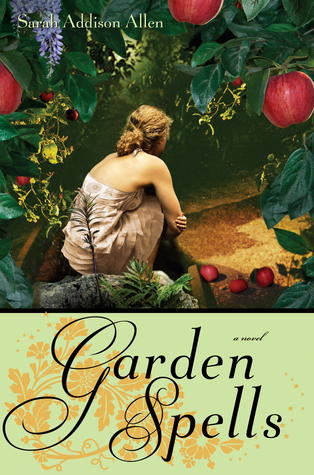 Garden Spells (2007) by Sarah Addison Allen is a book about family with just a touch of fantasy, and a Southern romance with a lot of whimsy.
I loved the quirky setting and the exaggerated characters of each of the families in this small, unique town. And I liked how fantasy elements were just woven into the story, as if that's how things are in the real world -- magic is always just right there under the surface waiting for the right circumstances to come out. Even a simple, everyday action like cooking food or cutting hair can create its own magic.
But the magic was only a small part of the book; the story itself is about relationships: romantic and familial, exciting, strained, and violent. At the heart of the story is the bond between two sisters who have had an unusual and not altogether loving relationship in the past. But the differences that kept them apart as children and young adults are also the things that have the potential to connect them as adults now that they are reunited. I liked that this was the relationship at the core of the book, and the rest of the story lines with romantic partners and others was important but somewhat secondary.
The secondary characters were all interesting and compelling, and the main characters were very easy to like and sympathize with. That combined with a great story and lovely, unique setting made this a really wonderful book.
“When you're happy for yourself, it fills you. When you're happy for someone else, it pours over. It was almost too bright to watch.”
Keep reading! Beth
Monday, November 16, 2015
John Green, Pt. 1: The early works
In addition to Neil Gaiman, the other author of whom I have long been a fan without having read much (or any) of his books is John Green. I am a devoted fan of the many educational YouTube channels John and his brother Hank produce, including VlogBrothers, Crash Course, SciShow, and Mental Floss, and the podcast they do together, Dear Hank and John (all are wonderful and interesting). Both Green brothers are intelligent, funny, and kind, and I admire them both. About time, then, that I explored the many books that brought John Green to attention in the first place, starting with some of his earlier works.
Looking for Alaska (2005)
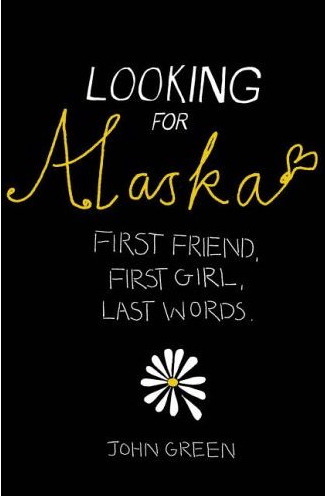 Unfortunately I do have to start by saying that at first I was not especially taken with this book, filled as it was with either awkward, whiny teenagers or rebellious, irresponsible teenagers. I just didn’t connect with the characters at first, which I think is more of a function of the genre than the author. Contemporary Young Adult novels are not normally my genre of choice; what YA books I read are all fantasy-based. So I wonder how much of my initial reluctance was simply the lack of magic and mythology I'm used to in YA books.
Regardless, once I got to know the characters more, and especially their back stories, I liked them much more. The way the story dealt with death in the later part was very moving and – I think – pretty accurate. Of course everyone deals with death differently, so I’m not sure it would have been possible to have been inaccurate per se, but regardless it felt very real and personal to me and helped me connect with the way the characters were feeling. And there were some very nice life lessons in the end.
An Abundance of Katherines (2006)
 I did enjoy this book more than Alaska from the start. Though there was still a bit more teen angst than I’m accustomed to in the stories I choose to read, I liked all the main characters in this story much more quickly. Though I’m not sure what it says about my deeper foray into YA literature that maybe the character I liked the best was the adult (maybe that’s a sign that I’m getting to old to read YA – to which I say, no such thing! I still read children’s books too).
One major plot thread – taking down oral histories of members in a specific community – was something I found very intriguing, and I really appreciated that the characters were working toward something interesting and concrete. This connection with the community, especially with outsiders (as the two main characters were), I thought elevated the book beyond just 'YA' to a story that is relatable to all ages (though I don't really think most YA books should be read just by teenagers; I know many adults who read them).
I like that John Green doesn’t speak down to his readers, that he assumes a certain amount of intelligence on our part (not an unreasonable amount; he is neither snobby nor preachy in his writing, which is also certainly appreciated). Overall, I'm glad I read both these books and look forward to reading some of his later works sometime soon.
Keep reading! Beth
Looking for Alaska (2005)
Unfortunately I do have to start by saying that at first I was not especially taken with this book, filled as it was with either awkward, whiny teenagers or rebellious, irresponsible teenagers. I just didn’t connect with the characters at first, which I think is more of a function of the genre than the author. Contemporary Young Adult novels are not normally my genre of choice; what YA books I read are all fantasy-based. So I wonder how much of my initial reluctance was simply the lack of magic and mythology I'm used to in YA books.Regardless, once I got to know the characters more, and especially their back stories, I liked them much more. The way the story dealt with death in the later part was very moving and – I think – pretty accurate. Of course everyone deals with death differently, so I’m not sure it would have been possible to have been inaccurate per se, but regardless it felt very real and personal to me and helped me connect with the way the characters were feeling. And there were some very nice life lessons in the end.
"We need never be hopeless, because we can never be irreparably broken... We cannot be born, and we cannot die. Like all energy, we can only change shapes and sizes and manifestations... [T]hat part of us greater than the sum of our parts cannot begin and cannot end, and so it cannot fail." (page 220-1)
An Abundance of Katherines (2006)
I did enjoy this book more than Alaska from the start. Though there was still a bit more teen angst than I’m accustomed to in the stories I choose to read, I liked all the main characters in this story much more quickly. Though I’m not sure what it says about my deeper foray into YA literature that maybe the character I liked the best was the adult (maybe that’s a sign that I’m getting to old to read YA – to which I say, no such thing! I still read children’s books too).One major plot thread – taking down oral histories of members in a specific community – was something I found very intriguing, and I really appreciated that the characters were working toward something interesting and concrete. This connection with the community, especially with outsiders (as the two main characters were), I thought elevated the book beyond just 'YA' to a story that is relatable to all ages (though I don't really think most YA books should be read just by teenagers; I know many adults who read them).
"I don't think you can ever fill the empty space with the thing you lost... I don't think your missing pieces ever fit inside you again once they go missing." (page 201)
I like that John Green doesn’t speak down to his readers, that he assumes a certain amount of intelligence on our part (not an unreasonable amount; he is neither snobby nor preachy in his writing, which is also certainly appreciated). Overall, I'm glad I read both these books and look forward to reading some of his later works sometime soon.
Keep reading! Beth
Monday, October 5, 2015
Roundtable Review: Go Set a Watchman
In which several members of our staff who have all read the same book offer their differing thoughts and opinions. Today: the controversial follow-up to Harper Lee's To Kill a Mockingbird. Please note, there WILL be spoilers as we discuss all aspects of this book, including the ending!

Ellen: Reading Go Set a Watchman was a fascinating experience for me. As someone who grew up in the 1960s in the racially tense setting of NYC, I had always found the attitude of Atticus and Scout towards the black community in Maycomb patronizing. What a revelation to read Jean Louise's anger and frustration regarding race relations in Watchman!
As a member of our DFL discussion of the two books said, "Too bad Harper Lee didn't follow up Mockingbird with another book based on Watchman but with the benefit of the terrific editing skills of Tay Hohoff." Perhaps Hohoff thought the public wouldn't be able to respond positively to a more strident narrator. The voice of Scout in Mockingbird is so clear and she shows rather than tells, which makes that book a masterpiece and Watchman a rough draft. We also found the class distinctions in Watchman fascinating to discuss. I agree with the Library Journal's Barbara Hoffert's review which says of Watchman, "Disturbing, important, and not to be compared with Mockingbird; this book is its own signal work."
Judy: From the time I heard that the new Harper Lee novel, Go Set a Watchman, was to be released, I waited patiently for its arrival. I wanted to go back to Atticus, Scout, Calpurnia, and the rest of the characters living in Macomb County. It was worth the wait. Once again, I was holding a book by Harper Lee and clearly, in my opinion, it WAS written by Ms. Lee.
Of course, the story was different and, after reading many reviews, I was prepared when Scout/Jean Louise, looking back at her childhood, was disenchanted with what she found. Atticus was not the hero she portrayed in Mockingbird. He was simply a man – a good man – who was living with the beliefs of many men of his time, and who would have changed his racial views as time progressed.
Unfortunately, issues of race had not changed much from the 1930s to the 1950s in Alabama, and coming to terms with life in Maycomb, and with Atticus in particular, was painful for Scout, now a city girl living in the more liberal Northeast. Scout's life and her relationships with family and friends were affected by what she found out about Atticus on one of her annual visits. However, the insightfulness of Atticus prevailed as before and he helped Scout resolve her conflict and move into adulthood as an independent person.
I loved holding the book, I loved reading the book, and I love the poetic and sublime writing of Harper Lee.
Pat: Before I read the book, I had read some reviews of it in magazines and online. One of the comments made was not to look at the book as a prequel or a sequel, but to read it as a completely "stand alone" novel. With this in mind I read the book and struggled right from the beginning. My immediate feeling was that I was not a fan of the "grownup" Scout at all. I found her very abrasive, not particularly sensitive, cynical, and foul-mouthed. While I admired her strength and independence, especially as a young woman during this time period in history, I just did not find her likable.
It was at this point that I realized that no matter how hard I tried, I would not be able to read this book as a completely separate novel from the first book, or even from the movie. You can't 'unread' a book that you've already read and loved. You can't 'unsee' one of the greatest movies of all time. So that advice from the critics I had to completely throw out the window. I realized I was most definitely biased right from the beginning. As I plodded through the book, my negative feelings about Scout did not change, and continued right to the end. She bitterly confronts Atticus at the end of the book, with a string of angry, mean, abusive, and foul-mouthed words, and I just couldn't get past where this anger came from, and the fact that Atticus was at the other end of it. It just didn't seem to fit the character. In the end, when Scout finally realizes why she was so angry at Atticus, it was just too late for me to find much redemption in this character. For a child who so loved her father, and idolized him to such a huge degree, it just never made sense to me why she would be so abusive to him. To me, it just seemed almost unrealistic.
Suzanne: For me, the best part of Go Set a Watchman was re-reading To Kill A Mockingbird in anticipation of the release. While I have some issues with Mockingbird, it is a well-written, engaging story... Go Set A Watchman is not. It is clearly a first draft. Most of the book consists of conversations between Jean Louise Finch and people who are simply explaining their points of view, with hardly any action or character building. There are two scenes that stand out for being charming and fun to read – both memories Jean Louise has of when she was a child and teenager. Good for Harper Lee's editor for recognizing that there was potential in those scenes and for steering her in that direction into what became Mockingbird.
Even if you haven't heard too much about this book, you have probably heard that the character of Atticus Finch is different than how he appears in Mockingbird. In this book, he is tolerant of hearing people's extremely racist points of view, does not believe that the NAACP and SCOTUS rulings in favor of civil rights will help African Americans, and was a member of the Ku Klux Klan during his youth because it was an organization that every white man was supposed to join. The plot of this book is Jean Louise being horrified by this revelation and coming to terms with her feelings about her father.
I am going to spoil the ending here. Jean Louise cannot reconcile the fact that her father is her hero with the new knowledge that he has such backwards views about race, and so she decides she can't ever see him again. When she tries to leave town, her uncle punches her in the face and calls her a bigot (for being color-blind), then makes her feel better with a glass of whiskey. Apparently that is exactly what she needed, because she is then able to reconcile with Atticus, accepting him as just a man who loves her, although no longer her hero. What a reader in 2015 is supposed to take away as the message of this book, I just don't know. Sometimes the people you love are surprisingly racist?
There is one character that we do not get to hear going on and on at length about race and the South, and that is Calpurnia. She is the Finch's former housekeeper, a black woman that Jean Louise thinks of as the closest person to a mother that she had. When Jean Louise visits Calpurnia, she doesn't say much to Jean Louise, which the reader is told means that she no longer loves the Finch family like her own, but just thinks of them as merely white people. Hearing from the black characters about how they view the changes in society would have been interesting and also illuminating to the book's other characters. But maybe that was beyond the scope of Harper Lee's abilities, as a white Southern writer living in the 1950s.
As a member of our DFL discussion of the two books said, "Too bad Harper Lee didn't follow up Mockingbird with another book based on Watchman but with the benefit of the terrific editing skills of Tay Hohoff." Perhaps Hohoff thought the public wouldn't be able to respond positively to a more strident narrator. The voice of Scout in Mockingbird is so clear and she shows rather than tells, which makes that book a masterpiece and Watchman a rough draft. We also found the class distinctions in Watchman fascinating to discuss. I agree with the Library Journal's Barbara Hoffert's review which says of Watchman, "Disturbing, important, and not to be compared with Mockingbird; this book is its own signal work."
Judy: From the time I heard that the new Harper Lee novel, Go Set a Watchman, was to be released, I waited patiently for its arrival. I wanted to go back to Atticus, Scout, Calpurnia, and the rest of the characters living in Macomb County. It was worth the wait. Once again, I was holding a book by Harper Lee and clearly, in my opinion, it WAS written by Ms. Lee.
Of course, the story was different and, after reading many reviews, I was prepared when Scout/Jean Louise, looking back at her childhood, was disenchanted with what she found. Atticus was not the hero she portrayed in Mockingbird. He was simply a man – a good man – who was living with the beliefs of many men of his time, and who would have changed his racial views as time progressed.
Unfortunately, issues of race had not changed much from the 1930s to the 1950s in Alabama, and coming to terms with life in Maycomb, and with Atticus in particular, was painful for Scout, now a city girl living in the more liberal Northeast. Scout's life and her relationships with family and friends were affected by what she found out about Atticus on one of her annual visits. However, the insightfulness of Atticus prevailed as before and he helped Scout resolve her conflict and move into adulthood as an independent person.
I loved holding the book, I loved reading the book, and I love the poetic and sublime writing of Harper Lee.
Pat: Before I read the book, I had read some reviews of it in magazines and online. One of the comments made was not to look at the book as a prequel or a sequel, but to read it as a completely "stand alone" novel. With this in mind I read the book and struggled right from the beginning. My immediate feeling was that I was not a fan of the "grownup" Scout at all. I found her very abrasive, not particularly sensitive, cynical, and foul-mouthed. While I admired her strength and independence, especially as a young woman during this time period in history, I just did not find her likable.
It was at this point that I realized that no matter how hard I tried, I would not be able to read this book as a completely separate novel from the first book, or even from the movie. You can't 'unread' a book that you've already read and loved. You can't 'unsee' one of the greatest movies of all time. So that advice from the critics I had to completely throw out the window. I realized I was most definitely biased right from the beginning. As I plodded through the book, my negative feelings about Scout did not change, and continued right to the end. She bitterly confronts Atticus at the end of the book, with a string of angry, mean, abusive, and foul-mouthed words, and I just couldn't get past where this anger came from, and the fact that Atticus was at the other end of it. It just didn't seem to fit the character. In the end, when Scout finally realizes why she was so angry at Atticus, it was just too late for me to find much redemption in this character. For a child who so loved her father, and idolized him to such a huge degree, it just never made sense to me why she would be so abusive to him. To me, it just seemed almost unrealistic.
Suzanne: For me, the best part of Go Set a Watchman was re-reading To Kill A Mockingbird in anticipation of the release. While I have some issues with Mockingbird, it is a well-written, engaging story... Go Set A Watchman is not. It is clearly a first draft. Most of the book consists of conversations between Jean Louise Finch and people who are simply explaining their points of view, with hardly any action or character building. There are two scenes that stand out for being charming and fun to read – both memories Jean Louise has of when she was a child and teenager. Good for Harper Lee's editor for recognizing that there was potential in those scenes and for steering her in that direction into what became Mockingbird.
Even if you haven't heard too much about this book, you have probably heard that the character of Atticus Finch is different than how he appears in Mockingbird. In this book, he is tolerant of hearing people's extremely racist points of view, does not believe that the NAACP and SCOTUS rulings in favor of civil rights will help African Americans, and was a member of the Ku Klux Klan during his youth because it was an organization that every white man was supposed to join. The plot of this book is Jean Louise being horrified by this revelation and coming to terms with her feelings about her father.
I am going to spoil the ending here. Jean Louise cannot reconcile the fact that her father is her hero with the new knowledge that he has such backwards views about race, and so she decides she can't ever see him again. When she tries to leave town, her uncle punches her in the face and calls her a bigot (for being color-blind), then makes her feel better with a glass of whiskey. Apparently that is exactly what she needed, because she is then able to reconcile with Atticus, accepting him as just a man who loves her, although no longer her hero. What a reader in 2015 is supposed to take away as the message of this book, I just don't know. Sometimes the people you love are surprisingly racist?
There is one character that we do not get to hear going on and on at length about race and the South, and that is Calpurnia. She is the Finch's former housekeeper, a black woman that Jean Louise thinks of as the closest person to a mother that she had. When Jean Louise visits Calpurnia, she doesn't say much to Jean Louise, which the reader is told means that she no longer loves the Finch family like her own, but just thinks of them as merely white people. Hearing from the black characters about how they view the changes in society would have been interesting and also illuminating to the book's other characters. But maybe that was beyond the scope of Harper Lee's abilities, as a white Southern writer living in the 1950s.
Read this book if you are interested in seeing how obvious
it is that writers need to write many drafts (with the help of editors),
or if you like reading arguments in favor of state's rights vs. the Supreme
Court. If you are interested in the ongoing, complicated state of race in
America, you should probably read Between the World and Me by Ta-Nehisi Coates, which was released at the same time this summer.
Clearly, the staff had very different opinions about the book! What did you think of Go Set a Watchman?
Subscribe to:
Posts (Atom)